Learn what every symbol on the card means.Full credits and sources at beakbrain.com/symbols
 ForestMedium · 72 g


ID tip
Overall the chestnut-capped piha is a dark grey bird with a notable chestnut crown on the upper nape and pale cinnamon-colored undertail coverts. The upperparts and wing coverts are a dark grey with paler fringes to most of the feathers. The flight feathers are a dark brownish grey with cinnamon-colored fringes on the secondaries and tertials. As the bird's feathers wear, the pale fringes tend to darken, leaving the bird even more uniform grey in coloration. The underwing is a pale silvery grey. The underparts are a paler shade of grey than the upperparts, particularly on the throat. Voice: Like most pihas, the chestnut-capped piha is extremely and conspicuously vocal. Its call is a loud, piercing sreeck which rises in pitch before abruptly descending. These calls are given repetitively in a series at one-second intervals, although when agitated they can be given every third of a second, and can be heard over 100 m (330 ft) away.
Text from Wikipedia, licensed CC BY-SA 4.0.
When to see the Chestnut-capped Piha
One bar for each month, and every month is filled: this bird is recorded here in all twelve. The wide bar is February, the month with the most records.
Where to see the Chestnut-capped Piha
The map shades 1 country with regular records. Everything unshaded has no records. Countries are listed below the map.
About the Chestnut-capped Piha
The chestnut-capped piha is a species of bird in the family Cotingidae. It is endemic to a small portion of Colombia's central Andes in the department of Antioquia. The chestnut-capped piha resides only in a narrow band of humid premontane cloud forest. It is a dark grey passerine with a notable chestnut crown on the upper nape and pale cinnamon-colored undertail coverts. Adults are small for pihas, measuring about 20 to 25 cm long. Males have modified primary feathers with elongated and stiff barbules that enable them to create a whirring noise with their wings, which the piha likely uses for display purposes. Its call is extremely loud and can be heard over 100 m (330 ft) away.
Text adapted from Wikipedia, licensed CC BY-SA 4.0.
Easily confused with
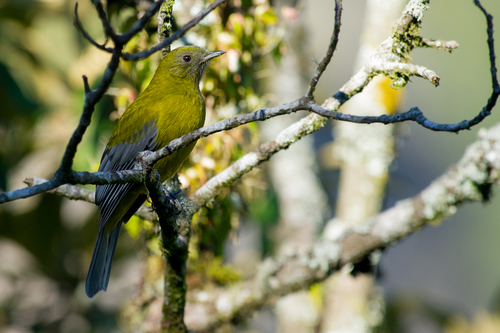 Grey-winged CotingaLipaugus conditusThe grey-winged cotinga is about 24 cm (9.4 in) long.
 Rose-collared PihaLipaugus streptophorusThe rose-collared piha is 20 to 22 cm (7.9 to 8.7 in) long.
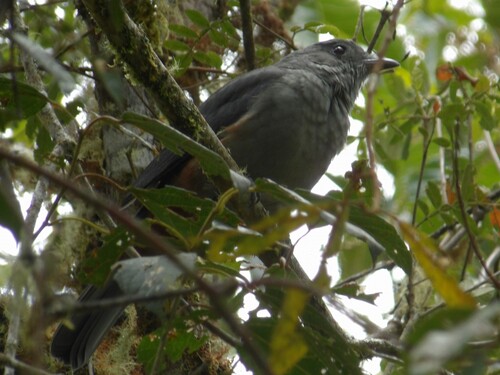 Scimitar-winged PihaLipaugus uropygialisThe scimitar-winged piha is 30 cm (12 in) long; one male weighed 116 g (4.1 oz) and one female 135 g (4.8 oz).
Learn the Chestnut-capped Piha in the BeakBrain App
Photo and call practice. Coming soon to iPhone and Android.
Play today's Daily BirdEvery photo and recording on this page is credited to its author under the licence shown. Spotted a problem with this page, or have a better photo? Contribute.