Learn what every symbol on the card means.Full credits and sources at beakbrain.com/symbols
 ForestCup nestSmall · 26 g
ID tip
It is a small dark bird with a relatively stout bill, brown upperparts and crown (the latter often tinged rufous), a white supercilium, and pinkish-grey legs. The male has a black frontlet, face and throat, a rufous chest, and buff or white belly. The female has a rufous face, throat and chest, and a buff or white belly. Males of the subspecies snethlageae and pallida are distinctive, as the black of the face and throat extends well onto the central chest, with rufous of the underparts limitied to the edge of the black chest.
Text from Wikipedia, licensed CC BY-SA 4.0.
When to see the Chestnut-belted Gnateater
One bar for each month. Filled bars are the 11 months with records; pale bars are months with none. The wide bar is July, the month with the most records.
Where to see the Chestnut-belted Gnateater
The map shades 6 countries with regular records. Everything unshaded has no records. Countries are listed below the map.
About the Chestnut-belted Gnateater
The chestnut-belted gnateater is a species of bird in the family Conopophagidae, the gnateaters. It is found in the Amazon Basin of northern Brazil, southern Colombia and eastern Peru and Ecuador; also the Guianan countries of Guyana, Suriname and eastern French Guiana. Its natural habitat is tropical moist lowland forest.
Text adapted from Wikipedia, licensed CC BY-SA 4.0.
Easily confused with
 Ceara GnateaterConopophaga cearaeThey are about 11.5 to 14 cm (4.5 to 5.5 in) long and weigh on average 24.5g (0.86 oz).
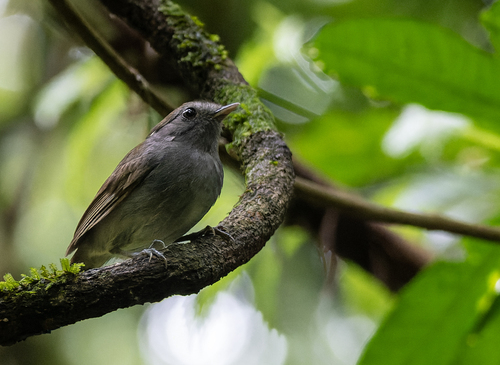 Slaty GnateaterConopophaga ardesiacaThe slaty gnateater is 12.5 to 14 cm (4.9 to 5.5 in) long, and 57 specimens had a mean weight of 26.3 g (0.93 oz).
 Ash-throated GnateaterConopophaga peruvianaThe ash-throated gnateater is 11 to 12 cm (4.3 to 4.7 in) long and weighs 22 to 26 g (0.78 to 0.92 oz).
Learn the Chestnut-belted Gnateater in the BeakBrain App
Photo and call practice. Coming soon to iPhone and Android.
Play today's Daily BirdEvery photo and recording on this page is credited to its author under the licence shown. Spotted a problem with this page, or have a better photo? Contribute.