Learn what every symbol on the card means.Full credits and sources at beakbrain.com/symbols
 WoodlandCup nestSmall · 32 g


What the Cedar Waxwing sounds like


ID tip
Cedar waxwings are medium-sized birds around 6–7 in (15–18 cm) long and weighing roughly 30 g (1 oz). Wingspan ranges from 8.7 to 11.8 in (22 to 30 cm). They are smaller and browner than their close relative, the Bohemian waxwing (which breeds farther to the north and west). Their markings are a "silky, shiny collection of brown, gray, and lemon-yellow, accented with a subdued crest, rakish black mask, and brilliant-red wax droplets on the wing feathers." These droplets may be the same colour as the madrone berries they are known to eat. Voice: The two common calls of these birds include very high-pitched whistles and buzzy trills about a half-second long, often represented as see or sree. Its call can also be described as "high, thin, whistles." They call often, especially in flight.
Text from Wikipedia, licensed CC BY-SA 4.0.
When to see the Cedar Waxwing
One bar for each month. Filled bars are the 11 months with records; pale bars are months with none. The wide bar is June, the month with the most records.
Where to see the Cedar Waxwing
The map shades 18 countries with regular records, and 4 more in a lighter tone where the bird turns up only as a stray. Everything unshaded has no records. Countries are listed below the map.
Recorded as a rare visitor in United Kingdom, Colombia, Portugal, Martinique.
About the Cedar Waxwing
The cedar waxwing is a member of the family Bombycillidae or waxwing family of passerine birds. It is a medium-sized bird that is mainly brown, gray, and yellow. Some of the wing feathers have red tips, which resemble sealing wax, giving the bird its common name. It is a native of North and Central America, breeding in open wooded areas in southern Canada and wintering in the southern half of the United States, Central America, and the far northwest of South America. Its diet includes cedar cones, fruit, holly berries, and insects. The cedar waxwing is listed as least concern on the IUCN Red List.
Text adapted from Wikipedia, licensed CC BY-SA 4.0.
Easily confused with
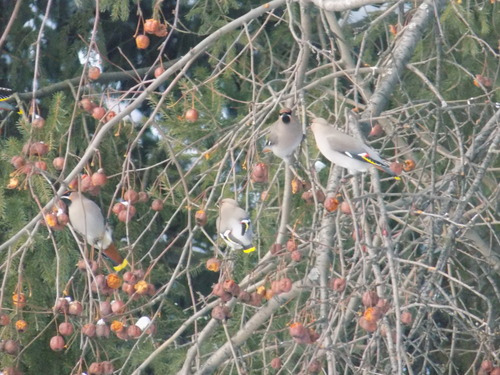 Bohemian WaxwingBombycilla garrulusThe Bohemian waxwing is a starling-sized bird 19–23 cm (7.5–9.1 in) in length with a 32–35.5 cm (12.6–14.0 in) wingspan, and an average weight of 55 g (1.9 oz).
 Japanese WaxwingBombycilla japonicaThe Japanese waxwing is 15–18 cm in length with a weight of 54–64 g, and its plumage is mostly pinkish-brown.
Side by side: Bohemian Waxwing vs Cedar Waxwing · Cedar Waxwing vs Japanese Waxwing
Learn the Cedar Waxwing in the BeakBrain App
Photo and call practice. Coming soon to iPhone and Android.
Play today's Daily BirdEvery photo and recording on this page is credited to its author under the licence shown. Spotted a problem with this page, or have a better photo? Contribute.