Learn what every symbol on the card means.Full credits and sources at beakbrain.com/symbols
 MarineCavity nestLarge · 311 g


ID tip
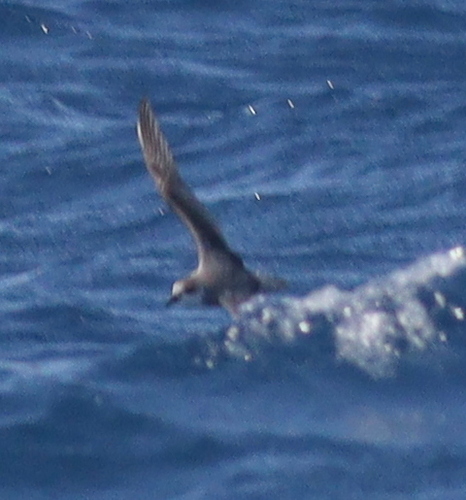
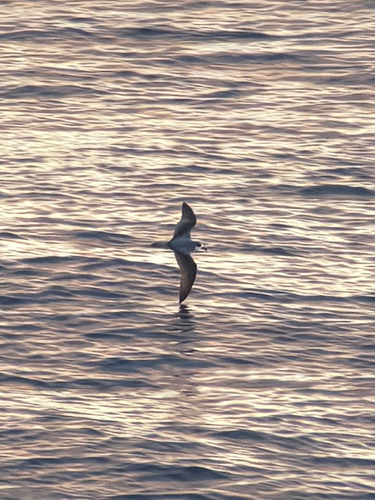
This long-winged petrel is 33–36 cm in length with an 86–94 cm wingspan. It has a grey back and wings, with a dark "W" marking across the wings. The undersides of the wings are dark and the belly is white. It has a fast impetuous flight. It picks planktonic food items from the ocean surface. This species is very similar to the Zino's petrel, but is larger and has a thicker black bill. As all three species in the Pterodroma feae/madeira/desertae complex were once believed to be subspecies of a single species: Pterodroma mollis, the extreme difficulty in telling them apart is easily understood.
Text from Wikipedia, licensed CC BY-SA 4.0.
When to see the Cape Verde Petrel
One bar for each month. Filled bars are the 7 months with records; pale bars are months with none. The wide bar is May, the month with the most records.
Where to see the Cape Verde Petrel
The map shades 3 countries with regular records, and 7 more in a lighter tone where the bird turns up only as a stray. Everything unshaded has no records. Countries are listed below the map.
Recorded as a rare visitor in United States, Spain, United Kingdom, France, Canada, French Guiana, Faroe Islands.
About the Cape Verde Petrel
Fea's petrel or the Cape Verde petrel is a small seabird in the gadfly petrel genus, Pterodroma. It was previously considered to be a subspecies of the soft-plumaged petrel, but they are actually not closely related at all. However, P. feae is very closely related to Zino's petrel and the Desertas petrel, two other species recently split from P. mollis. The gadfly petrels are named for their speedy weaving flight, as if evading horseflies. The flight action is also reflected in the genus name Pterodroma, from Ancient Greek pteron, "wing" and dromos, " runner". This species is named after the Italian zoologist Leonardo Fea (1852-1903).
Text adapted from Wikipedia, licensed CC BY-SA 4.0.
Easily confused with
 Masatierra PetrelPterodroma defilippianaMasatierra petrel grows to a length of about 26 centimetres (10 in).
 Bermuda PetrelPterodroma cahowThe Bermuda petrel is a gadfly petrel.
 White-necked PetrelPterodroma cervicalisThis species resembles the Vanuatu petrel, P. occulta, but is slightly larger at 43 cm (17 in) in length, 95–105 cm (37–41 in) in wing span and 380–545 g (13.4–19.2 oz) in weight.
Learn the Cape Verde Petrel in the BeakBrain App
Photo and call practice. Coming soon to iPhone and Android.
Play today's Daily BirdEvery photo and recording on this page is credited to its author under the licence shown. Spotted a problem with this page, or have a better photo? Contribute.