Learn what every symbol on the card means.Full credits and sources at beakbrain.com/symbols
 ShrublandScrapeLarge · 630 g


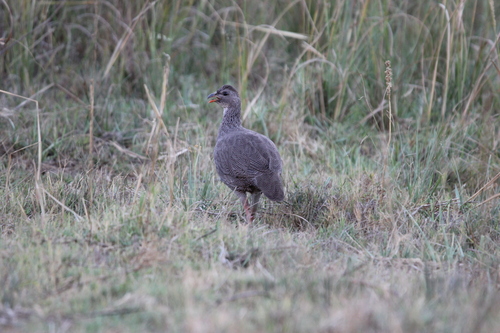
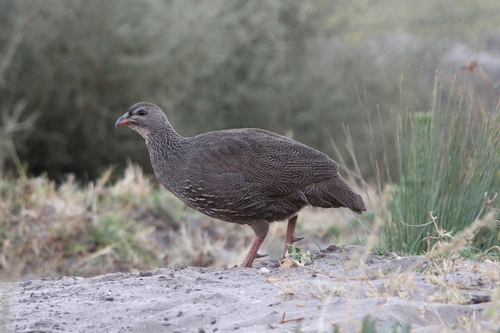

ID tip
The Cape spurfowl is 40–42 cm (16–17 in) in length. The male, at 600–915 g (1.323–2.017 lb), averages larger than the female, at 435–659 g (0.959–1.453 lb). This large spurfowl appears all dark from a distance, apart from the red legs, but when seen closer the plumage is finely vermiculated in grey and white, with a plainer crown and nape. The sexes are similar in plumage, but the male has two leg spurs, whereas the female has at best one short spur. The juvenile is similar to the adults, but has duller legs and clearer vermiculations.
Text from Wikipedia, licensed CC BY-SA 4.0.
When to see the Cape Spurfowl
One bar for each month, and every month is filled: this bird is recorded here in all twelve. The wide bar is September, the month with the most records.
Where to see the Cape Spurfowl
The map shades 2 countries with regular records. Everything unshaded has no records. Countries are listed below the map.
About the Cape Spurfowl
The Cape spurfowl or Cape francolin is a gamebird in the pheasant family Phasianidae. It is endemic to southern Africa, where it is the largest francolin. It occurs in the Western Cape province of South Africa, and locally northwards to southern Namibia. It has adapted to alien vegetation and a variety of human-altered habitats, but scrubby roosting and nesting space is a prerequisite. The species is not threatened.
Text adapted from Wikipedia, licensed CC BY-SA 4.0.
Easily confused with
 Red-necked SpurfowlPternistis aferThe red-necked spurfowl is 25–38 cm (9.8–15.0 in) in length, with significant size differences between the subspecies.
 Red-billed SpurfowlPternistis adspersusThe red-billed spurfowl, also known as the red-billed francolin, is a species of bird in the family Phasianidae.
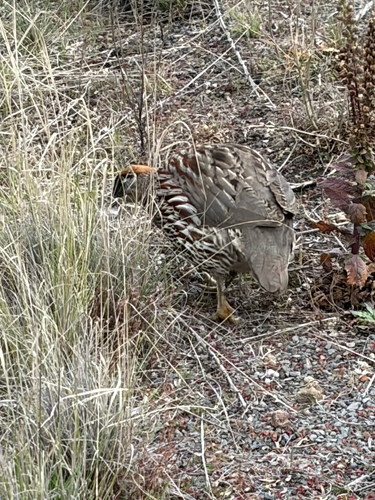 Erckel's SpurfowlPternistis erckeliiThe largest African spurfowl, Erckel's spurfowl is 38–43 cm (15–17 in) in length, with females being slightly smaller than males.
Side by side: Cape Spurfowl vs Red-necked Spurfowl · Cape Spurfowl vs Erckel's Spurfowl
Learn the Cape Spurfowl in the BeakBrain App
Photo and call practice. Coming soon to iPhone and Android.
Play today's Daily BirdEvery photo and recording on this page is credited to its author under the licence shown. Spotted a problem with this page, or have a better photo? Contribute.