Learn what every symbol on the card means.Full credits and sources at beakbrain.com/symbols
 ShrublandCavity nestMedium · 72 g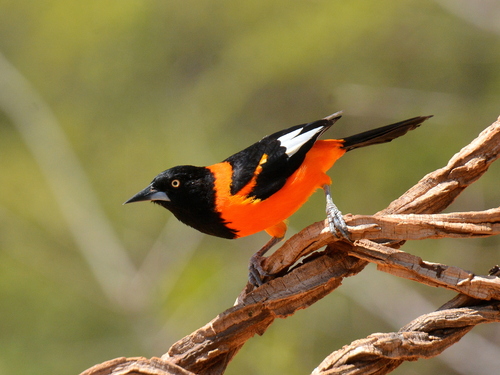


ID tip
The campo troupial is very similar in appearance to the Venezuelan troupial (Icterus icterus) with which it was at one time thought to be conspecific. It is a robust bird about 23 cm (9 in) long with a long tail and a broad beak. It is bright orange apart from a black hood and bib, back, wings and tail. There is an uneven line dividing the bib from the breast. It differs from the Venezuelan troupial in having only a small patch of white on its wings and hardly any bluish skin around its eye, and it has orange epaulettes on its shoulders whereas the Venezuelan bird does not.
Text from Wikipedia, licensed CC BY-SA 4.0.
When to see the Campo Troupial
One bar for each month, and every month is filled: this bird is recorded here in all twelve. The wide bar is October, the month with the most records.
Where to see the Campo Troupial
The map shades 1 country with regular records, and 6 more in a lighter tone where the bird turns up only as a stray. Everything unshaded has no records. Countries are listed below the map.
Recorded as a rare visitor in Argentina, Colombia, Bolivia, Guyana, Paraguay, Venezuela.
About the Campo Troupial
The campo troupial or campo oriole is a species of bird in the family Icteridae that is found in northeastern Brazil. At one time thought to be conspecific with the Venezuelan troupial and orange-backed troupial, it is now accepted as a separate species. It is a fairly common bird and the International Union for Conservation of Nature has rated it as a "least-concern species".
Text adapted from Wikipedia, licensed CC BY-SA 4.0.
Easily confused with


Learn the Campo Troupial in the BeakBrain App
Photo and call practice. Coming soon to iPhone and Android.
Play today's Daily BirdEvery photo and recording on this page is credited to its author under the licence shown. Spotted a problem with this page, or have a better photo? Contribute.