Learn what every symbol on the card means.Full credits and sources at beakbrain.com/symbols
 ForestCup nestMedium · 64 g
ID tip
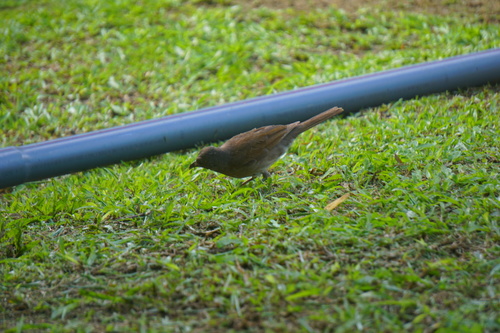
The campina thrush is 21.5 to 24 cm (8.5 to 9.4 in) long and weighs 50 to 66 g (1.8 to 2.3 oz). The sexes have the same plumage. Adults have a mostly dark grayish brown head with a dusky-streaked white throat. Their upperparts, wings, and tail are dark grayish brown. Their underparts are mostly dull gray that becomes dirty white on the lower belly and undertail coverts. They have a dark iris, a dusky black bill, and dusky black legs and feet. Juveniles are similar to adults but with buff spots and streaks on their upperparts, spotted buff wing bars, and brown mottling on their underparts. Voice: The campina thrush's song has not been analyzed in detail but has been likened to that of the American Robin.
Text from Wikipedia, licensed CC BY-SA 4.0.
When to see the Campina Thrush
One bar for each month. Filled bars are the 9 months with records; pale bars are months with none. The wide bar is January, the month with the most records.
Where to see the Campina Thrush
The map shades 4 countries with regular records, and 2 more in a lighter tone where the bird turns up only as a stray. Everything unshaded has no records. Countries are listed below the map.
About the Campina Thrush
The campina thrush is a species of bird in the family Turdidae. It is found in Bolivia, Brazil, Colombia, Guyana, Suriname, and Venezuela.
Text adapted from Wikipedia, licensed CC BY-SA 4.0.
Easily confused with
 Tristan ThrushTurdus eremitaThe bird was described by John Gould as being similar in size and appearance to the song thrush, and by Henry Moseley as like a very dark-coloured song thrush.
 Ethiopian ThrushTurdus simensisThe Ethiopian thrush is a species of bird in the family Turdidae.
Learn the Campina Thrush in the BeakBrain App
Photo and call practice. Coming soon to iPhone and Android.
Play today's Daily BirdEvery photo and recording on this page is credited to its author under the licence shown. Spotted a problem with this page, or have a better photo? Contribute.