Learn what every symbol on the card means.Full credits and sources at beakbrain.com/symbols
 ForestTiny · 3 g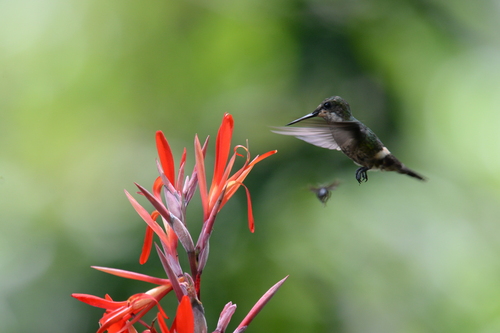
ID tip
The butterfly coquette is 7.5 to 9.1 cm (3.0 to 3.6 in) long. The male of the nominate subspecies has a deep green head with a long, red-tipped, green crest and long green "whiskers" with white tips. Its back is green with golden highlights, deep reddish uppertail coverts, and a white band on the rump. The underparts are green but for white thighs and the tail is maroon. The female does not have the crest and "whiskers" but does have a whitish malar patch. The uppertail coverts are a less intense red than those of the male and it has golden highlights on the breast. Both sexes of subspecies L. Voice: The butterfly coquette is usually silent but makes "short tsip or chip" calls when feeding. One audio recording is available at Cornell University's Macaulay Library.
Text from Wikipedia, licensed CC BY-SA 4.0.
When to see the Butterfly Coquette
One bar for each month. Filled bars are the 11 months with records; pale bars are months with none. The wide bar is October, the month with the most records.
Where to see the Butterfly Coquette
The map shades 6 countries with regular records. Everything unshaded has no records. Countries are listed below the map.
About the Butterfly Coquette
The butterfly coquette is a species of hummingbird in the "coquettes", tribe Lesbiini of subfamily Lesbiinae. It is found in Bolivia, Brazil, Colombia, Ecuador, Peru, and Venezuela.
Text adapted from Wikipedia, licensed CC BY-SA 4.0.
Easily confused with
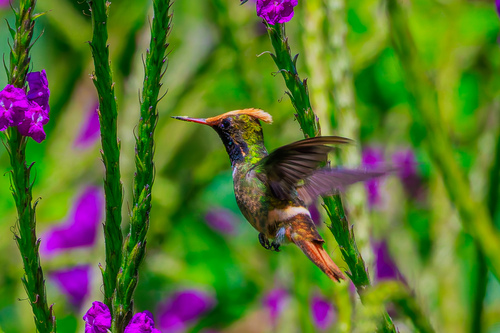 Spangled CoquetteLophornis stictolophusThe spangled coquette is 6.4 to 6.9 cm (2.5 to 2.7 in) long.
 Dot-eared CoquetteLophornis gouldiiThe dot-eared coquette is 6.8 to 7.6 cm (2.7 to 3.0 in) long and weighs 2.4 to 2.8 g (0.085 to 0.099 oz).
Peacock CoquetteLophornis pavoninusThe peacock coquette is about 9.7 cm (3.8 in) long.
Dot-eared CoquetteLophornis gouldiiThe dot-eared coquette is 6.8 to 7.6 cm (2.7 to 3.0 in) long and weighs 2.4 to 2.8 g (0.085 to 0.099 oz).
Peacock CoquetteLophornis pavoninusThe peacock coquette is about 9.7 cm (3.8 in) long.
Learn the Butterfly Coquette in the BeakBrain App
Photo and call practice. Coming soon to iPhone and Android.
Play today's Daily BirdEvery photo and recording on this page is credited to its author under the licence shown. Spotted a problem with this page, or have a better photo? Contribute.