Learn what every symbol on the card means.Full credits and sources at beakbrain.com/symbols
 GrasslandCavity nestMedium · 151 g


What the Burrowing Owl sounds like

ID tip
Burrowing owls have bright eyes; their beaks can be dark yellow or gray depending on the subspecies. They lack ear tufts and have a flattened facial disc. The owls have prominent white eyebrows and a white "chin" patch which they expand and display during certain behaviors, such as a bobbing of the head when agitated. Adults have brown heads and wings with white spotting. Their chests and abdomens are white with variable brown spotting or barring, also depending on the subspecies. Juvenile owls are similar in appearance, but they lack most of the white spotting above and brown barring below.
Text from Wikipedia, licensed CC BY-SA 4.0.
When to see the Burrowing Owl
One bar for each month, and every month is filled: this bird is recorded here in all twelve. The wide bar is May, the month with the most records.
Where to see the Burrowing Owl
The map shades 24 countries with regular records, and 2 more in a lighter tone where the bird turns up only as a stray. Everything unshaded has no records. Countries are listed below the map.
Recorded as a rare visitor in Costa Rica, France.
About the Burrowing Owl
The burrowing owl is a small, long-legged, primarily terrestrial—though not flightless—species of owl native to the open landscapes of North and South America. They are typically found in grasslands, rangelands, agricultural areas, deserts, or any other open, dry area with low vegetation. They nest and roost in burrows, and, despite their common name, do not often construct these dwellings themselves, rather repurposing disused burrows or tunnels previously excavated and inhabited by other species, such as American badgers, foxes, ground squirrels or prairie dogs, among others.
Text adapted from Wikipedia, licensed CC BY-SA 4.0.
Easily confused with
 Little OwlAthene noctuaThe little owl is a small owl with a flat-topped head, a plump, compact body and a short tail.
 Spotted OwletAthene bramaThe spotted owlet is a small and stocky bird, barely 21 cm (8.3 in) in size.
 White-browed OwlAthene superciliarisThe white-browed owl is a dumpy owl with a large, rounded head which does not have ear tufts.
Side by side: Burrowing Owl vs Little Owl · Burrowing Owl vs Spotted Owlet
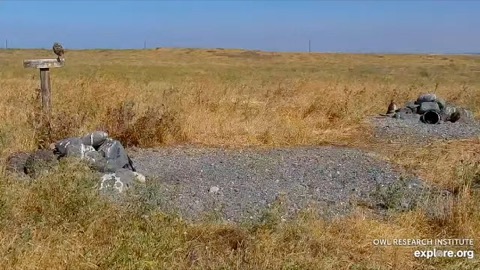
Watch the Burrowing Owl on live cams
 LIVE
LIVEBrowse all 118 bird cams worldwide, live and seasonal, by region and species.
Learn the Burrowing Owl in the BeakBrain App
Photo and call practice. Coming soon to iPhone and Android.
Play today's Daily BirdEvery photo and recording on this page is credited to its author under the licence shown. Spotted a problem with this page, or have a better photo? Contribute.