Learn what every symbol on the card means.Full credits and sources at beakbrain.com/symbols
 WoodlandCup nestTiny · 14 g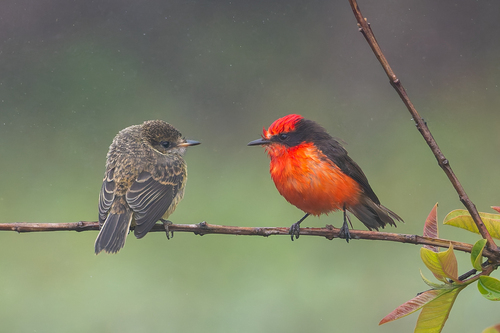


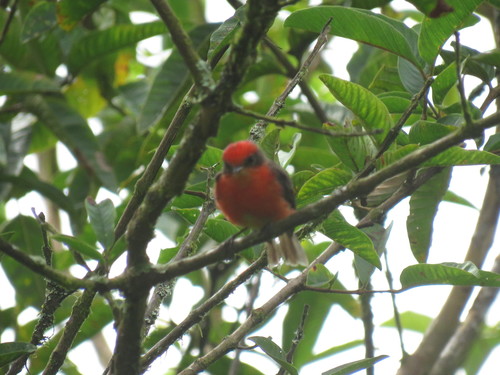
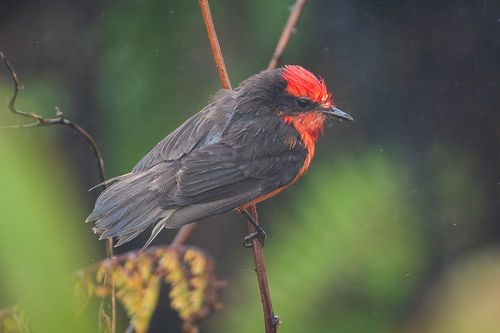
ID tip
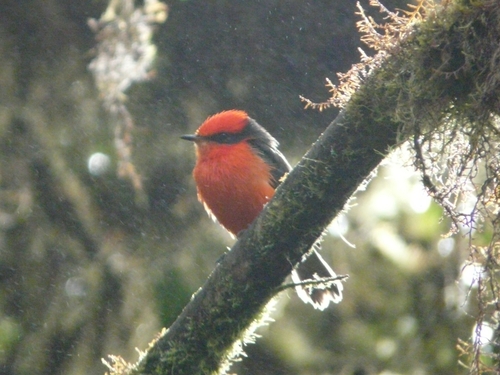
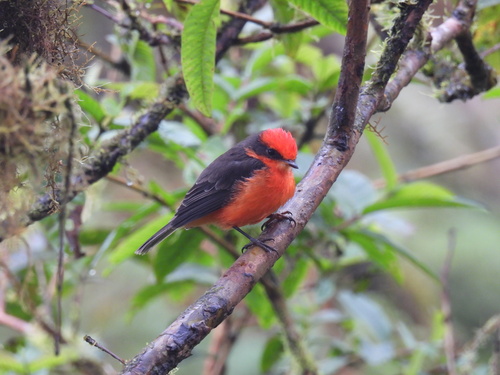
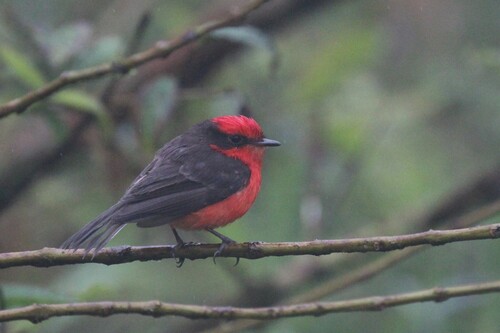
The brujo flycatcher is about 13 to 14 cm (5.1 to 5.5 in) long and weighs 11 to 14 g (0.39 to 0.49 oz). Adult males have a bright vermilion, scarlet, or orange forehead and crown down to the eye. Their lores and ear coverts are blackish brown and form a "mask" that continues around their nape. Their upperparts, wings, and tail are blackish brown, with slightly paler remiges and wing coverts. The lower part of their face, their throat, and their underparts are the same shade of red as their crown. Adult females have a grayish brown head with an indistinct grayish supercilium. Voice: As of April 2025 xeno-canto had seven recordings of the brujo flycatcher vocalizations and the Cornell Lab of Ornithology's Macaulay Library had 10 with no overlap between them. The species sings during an undulating circular flight display, with the song described as "loudly whispering chew wit" followed by a "sharp mechanical snap".
Text from Wikipedia, licensed CC BY-SA 4.0.
When to see the Brujo Flycatcher
One bar for each month. Filled bars are the 11 months with records; pale bars are months with none. The wide bar is July, the month with the most records.
Where to see the Brujo Flycatcher
The map shades 1 country with regular records. Everything unshaded has no records. Countries are listed below the map.
About the Brujo Flycatcher
The brujo flycatcher is a Near Threatened species of bird in the family Tyrannidae, the tyrant flycatchers. It is endemic to the Galápagos Islands. It is also known as the Darwin's flycatcher and little vermilion flycatcher.
Text adapted from Wikipedia, licensed CC BY-SA 4.0.
Easily confused with

Learn the Brujo Flycatcher in the BeakBrain App
Photo and call practice. Coming soon to iPhone and Android.
Play today's Daily BirdEvery photo and recording on this page is credited to its author under the licence shown. Spotted a problem with this page, or have a better photo? Contribute.