Learn what every symbol on the card means.Full credits and sources at beakbrain.com/symbols
 ForestCavity nestSmall · 55 g

ID tip
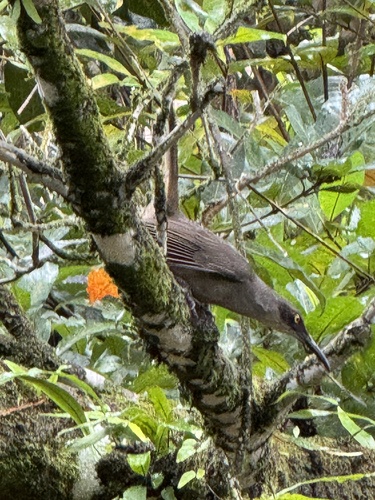
The nominate subspecies of brown trembler is 20.5 to 26 cm (8.1 to 10.2 in) long; males weigh 47.6 to 65.4 g (1.68 to 2.31 oz) and females 42.8 to 71 g (1.51 to 2.50 oz). The species has a long, slightly downcurved bill, the female's longer than the male's. Adults are mostly shades of brown. Their crown is a deep grayish brown, the nape less gray, the back an olive brown, and the rump and tail a reddish brown. The face is blackish through the eye with grayish olive brown cheeks. The chin and throat are pale grayish buff that becomes browner on the breast and belly. Voice: The brown trembler's principal song is "a series of variable loud phrases ranging in quality from 'rather harsh, others rich and warbled, still others high and squeaky'" It also has "subsongs" delivered less frequently. A common call is "a nasal, rasping yeeeah, often repeated many times".
Text from Wikipedia, licensed CC BY-SA 4.0.
When to see the Brown Trembler
One bar for each month. Filled bars are the 9 months with records; pale bars are months with none. The wide bar is April, the month with the most records.
Where to see the Brown Trembler
The map shades 9 countries with regular records. Everything unshaded has no records. Countries are listed below the map.
About the Brown Trembler
The brown trembler is a species of bird in the family Mimidae, the mockingbirds and thrashers. It is found on the islands of Saba, St. Kitts, Nevis, Montserrat, Guadeloupe, Dominica and St. Vincent in the Lesser Antilles of the Caribbean Sea.
Text adapted from Wikipedia, licensed CC BY-SA 4.0.
Easily confused with
Learn the Brown Trembler in the BeakBrain App
Photo and call practice. Coming soon to iPhone and Android.
Play today's Daily BirdEvery photo and recording on this page is credited to its author under the licence shown. Spotted a problem with this page, or have a better photo? Contribute.