Learn what every symbol on the card means.Full credits and sources at beakbrain.com/symbols
 ForestCup nestSmall · 15 g

ID tip
The Bonin white-eye is 12 to 14 cm (4.7–5.5 in) long and weighs around 15 g (0.53 oz). The nominate race has a yellow head with a conspicuous triangular black eye-patch which is linked by the thin black line to a black forehead. The white eye-ring is broken by a thin black line through the eye. The lores are yellow, as are the throat and upper breast. The back and wings are olive-green tinged with grey, and the primaries are tinged with brown. The tail is olive-brown, and the underparts are pale yellow, with a grey wash on the flanks. Voice: The Bonin white-eye was long thought to be an infrequent songster. Early accounts reported no singing from captive birds, and a report published in 1985 noted that while it did sing, it did so very irregularly. The same report concluded that the species did not use its call for territorial defence.
Text from Wikipedia, licensed CC BY-SA 4.0.
When to see the Bonin White-eye
One bar for each month. Filled bars are the 8 months with records; pale bars are months with none. The wide bar is July, the month with the most records.
Where to see the Bonin White-eye
The map shades 1 country with regular records. Everything unshaded has no records. Countries are listed below the map.
About the Bonin White-eye
The Bonin white-eye is a small species of songbird endemic to the Bonin Islands of Japan. It is the only species in the monotypic genus Apalopteron. The taxonomic affinities of the Bonin white-eye were a long-standing mystery and it was formerly placed with the bulbuls, babblers and more recently with the honeyeaters, during which it was known as the Bonin honeyeater. Since 1995 it is known to be a white-eye in the family Zosteropidae, that is closely related to the golden white-eye of the Marianas Islands.
Text adapted from Wikipedia, licensed CC BY-SA 4.0.
Easily confused with
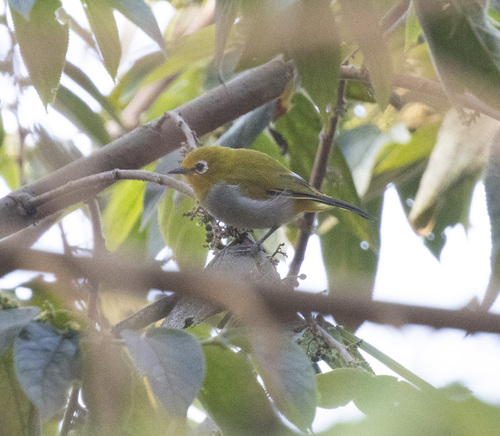 South Pare White-eyeZosterops winifredaeThe south Pare white-eye is a bird species in the family Zosteropidae.
Luzon Striped BabblerZosterornis striatusThe Luzon striped babbler is a species of bird in the family Zosteropidae.
South Pare White-eyeZosterops winifredaeThe south Pare white-eye is a bird species in the family Zosteropidae.
Luzon Striped BabblerZosterornis striatusThe Luzon striped babbler is a species of bird in the family Zosteropidae.
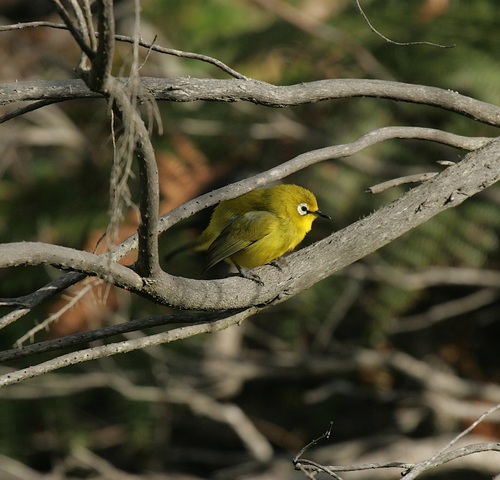 Kirk's White-eyeZosterops kirkiThey are around 10–12 centimetres (3.9–4.7 in) in length.
Learn the Bonin White-eye in the BeakBrain App
Photo and call practice. Coming soon to iPhone and Android.
Play today's Daily BirdEvery photo and recording on this page is credited to its author under the licence shown. Spotted a problem with this page, or have a better photo? Contribute.