Learn what every symbol on the card means.Full credits and sources at beakbrain.com/symbols
 GrasslandCup nestSmall · 31 g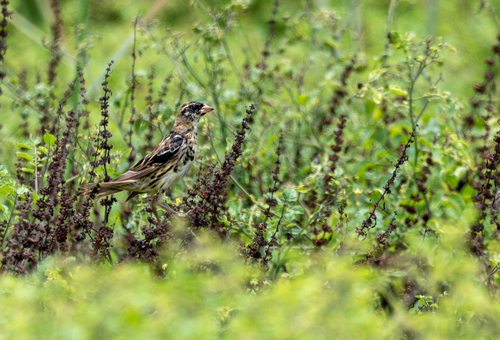
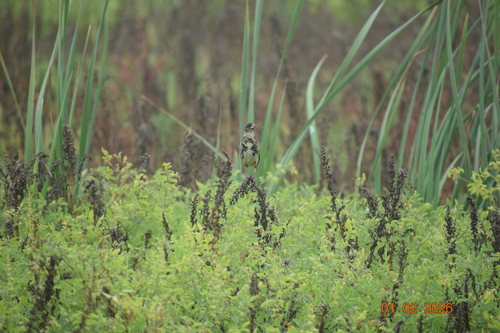


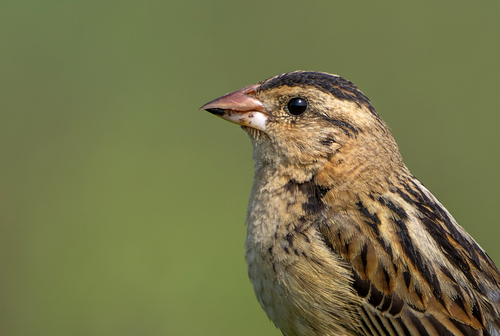
What the Bobolink sounds like


ID tip
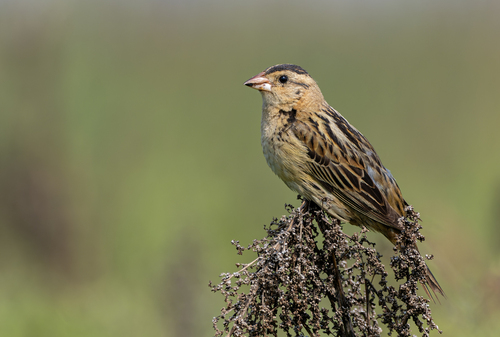
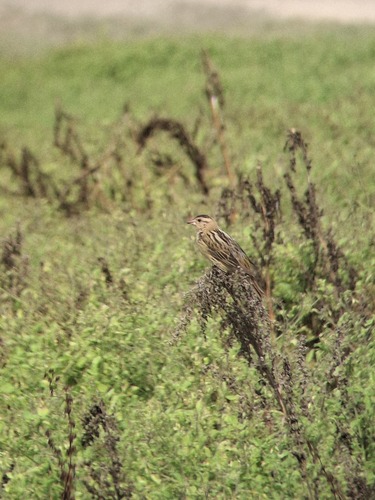
Measurements: Length: 5.9–8.3 in (15–21 cm) Weight: 1.0–2.0 oz (28–57 g) Wingspan: 10.6 inches (27 cm) Adults are 16–18 cm (6.3–7.1 in) long with short finch-like bills and weigh about 28 g (1 oz). Adult males are mostly black with creamy napes and white scapulars, lower backs, and rumps. Adult females are mostly light brown with black streaks on the back and flanks, and dark stripes on the head; their wings and tails are darker. Voice: Males have two song types, which they will sing both alone and together to make compound songs. Males sing both while perching and in flight, but compound songs are more likely during flight.
Text from Wikipedia, licensed CC BY-SA 4.0.
When to see the Bobolink
One bar for each month. Filled bars are the 5 months with records; pale bars are months with none. The wide bar is May, the month with the most records.
Where to see the Bobolink
The map shades 31 countries with regular records, and 13 more in a lighter tone where the bird turns up only as a stray. Everything unshaded has no records. Countries are listed below the map.
Recorded as a rare visitor in United Kingdom, Portugal, Chile, Ireland, Martinique, U.S. Virgin Islands, Dominica, Guyana, Jamaica, St. Barthélemy, St. Kitts & Nevis, St. Vincent & Grenadines, Spain.
About the Bobolink
The bobolink is a small New World blackbird and the only member of the genus Dolichonyx. An old name for this species is the "rice bird", from its tendency to feed on cultivated grains during winter and migration. The bobolink breeds in the summer in the United States and Canada, with most of the summer range in the northern U.S. Bobolinks winter in southern South America, primarily Paraguay, Argentina, and Bolivia. Bobolink numbers are rapidly declining due to factors such as agricultural intensification and habitat loss; they are considered threatened in Canada, and are at risk throughout their range.
Text adapted from Wikipedia, licensed CC BY-SA 4.0.
Easily confused with
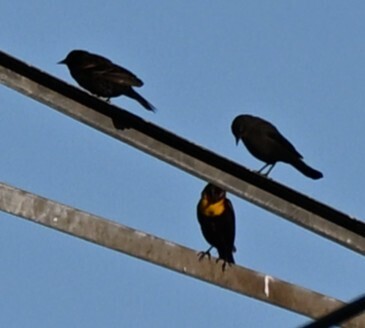 Yellow-headed BlackbirdXanthocephalus xanthocephalusYellow-headed blackbirds are relatively large blackbirds with large, yellow heads.
 Yellow-breasted ChatIcteria virensWhen considered part of the family Parulidae (New World warblers), the yellow-breasted chat was the largest species of parulid.
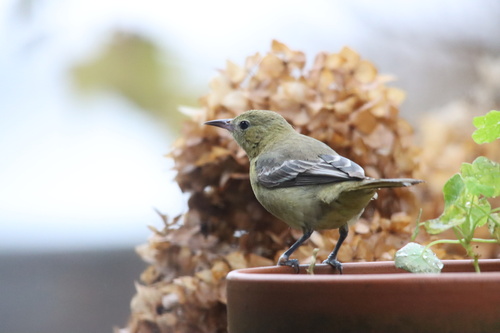 Hooded OrioleIcterus cucullatusThe hooded oriole is a medium-sized New World oriole.
Side by side: Bobolink vs Yellow-breasted Chat · Bobolink vs Yellow-headed Blackbird
Learn the Bobolink in the BeakBrain App
Photo and call practice. Coming soon to iPhone and Android.
Play today's Daily BirdEvery photo and recording on this page is credited to its author under the licence shown. Spotted a problem with this page, or have a better photo? Contribute.