Learn what every symbol on the card means.Full credits and sources at beakbrain.com/symbols
 GrasslandScrapeHuge · 1.5 kg



ID tip
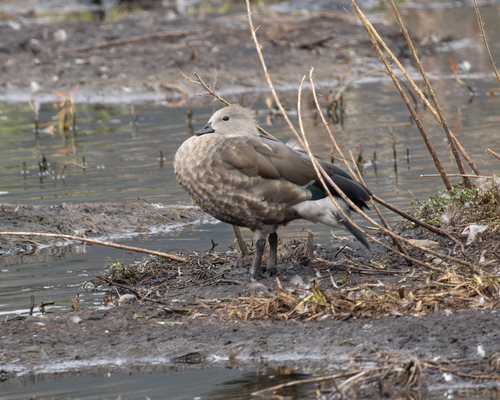
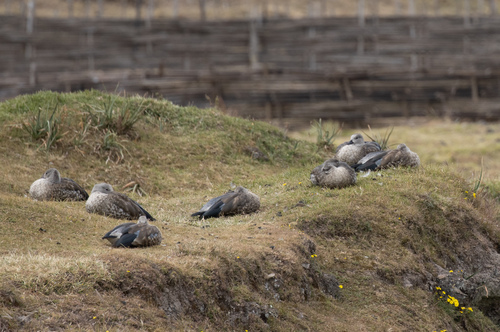
It is a stocky grey-brown goose-like bird about 60–75 centimetres (24–30 in) long with a slightly paler head and upper neck. It has a small black bill and black legs. Standing birds look fairly dull, grey and dirty white, sometimes showing the blue along the edge of the wing. The sexes are similar, but immature birds are duller. The plumage is thick and loose, an adaptation to the cold of the Ethiopian highlands. In flight, the pale blue upper forewing is conspicuous; the primary feathers are black, and the secondary feathers black glossed green. Voice: The blue-winged goose is a quiet species, but both sexes may give a high-pitched whistle; it does not honk or cackle like the true geese, but may make a barking alarm call when flushed.
Text from Wikipedia, licensed CC BY-SA 4.0.
When to see the Blue-winged Goose
One bar for each month. Filled bars are the 9 months with records; pale bars are months with none. The wide bar is November, the month with the most records.
Where to see the Blue-winged Goose
The map shades 1 country with regular records, and 4 more in a lighter tone where the bird turns up only as a stray. Everything unshaded has no records. Countries are listed below the map.
Recorded as a rare visitor in Spain, Netherlands, United Kingdom, United States.
About the Blue-winged Goose
The blue-winged goose is a waterfowl species which is endemic to Ethiopia. It is the only member of the genus Cyanochen.
Text adapted from Wikipedia, licensed CC BY-SA 4.0.
Easily confused with
 Scaly-sided MerganserMergus squamatusThis striking sea duck has a thin red bill and a scaled dark pattern on the flanks and rump.
 Chubut Steamer DuckTachyeres leucocephalusAdult male Chubut steamer ducks have white heads with a bright yellow/orange bill with a black nail.
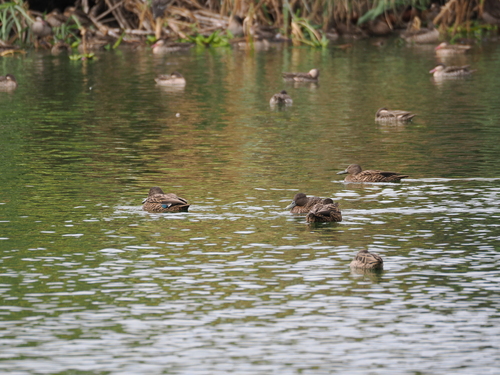 Meller's DuckAnas melleriThe Meller's duck resembles a large female mallard.
Learn the Blue-winged Goose in the BeakBrain App
Photo and call practice. Coming soon to iPhone and Android.
Play today's Daily BirdEvery photo and recording on this page is credited to its author under the licence shown. Spotted a problem with this page, or have a better photo? Contribute.