Learn what every symbol on the card means.Full credits and sources at beakbrain.com/symbols
 Grassland8 g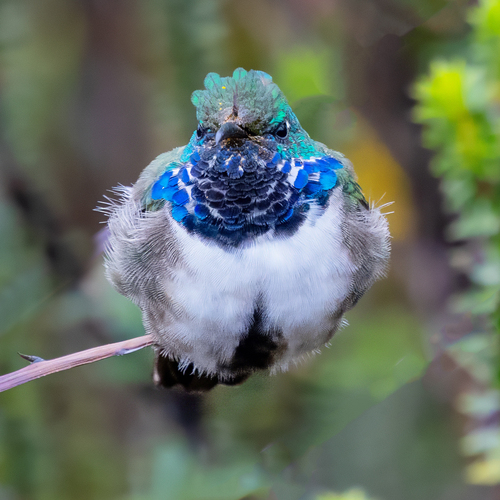
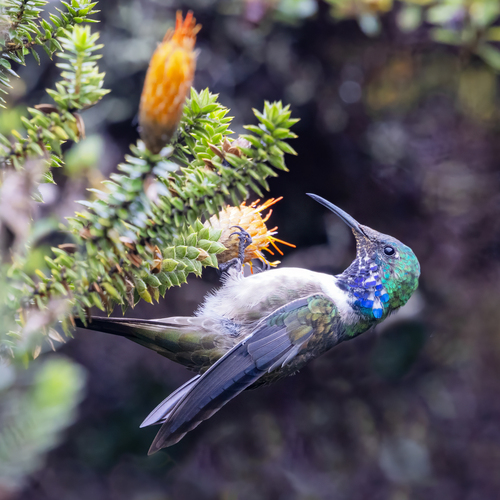
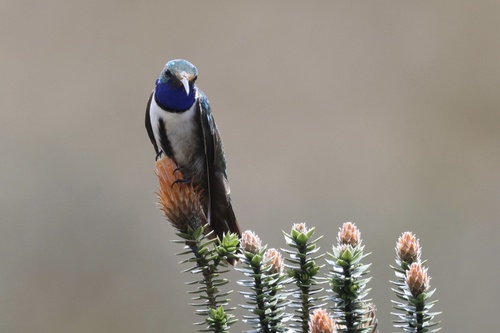
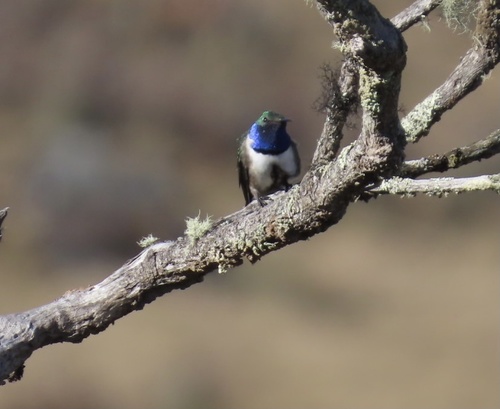
ID tip
The top of the head of the male blue-throated hillstar is iridescent emerald green, which extends from the forehead to the base of the crown. The iridescent highlights are blue-green. The nape of the neck, mantle, lower portion of the back, rump, and upperwing coverts are bright emerald green. Some feathers in these regions have blue-green edging, and some have bronze highlights. The uppertail coverts are emerald blue-green. The upper surface of the central flight feathers are blackish blue.
Text from Wikipedia, licensed CC BY-SA 4.0.
When to see the Blue-throated Hillstar
One bar for each month. Filled bars are the 11 months with records; pale bars are months with none. The wide bar is January, the month with the most records.
Where to see the Blue-throated Hillstar
The map shades 1 country with regular records. Everything unshaded has no records. Countries are listed below the map.
About the Blue-throated Hillstar
The blue-throated hillstar is a hummingbird found only in a small portion of the southwestern Andes in Ecuador. It was discovered in 2017.
Text adapted from Wikipedia, licensed CC BY-SA 4.0.
Easily confused with
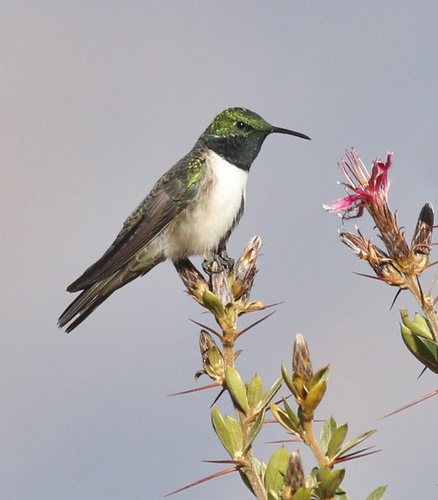 Green-headed HillstarOreotrochilus stolzmanniThe green-headed hillstar is a species of South American hummingbird ranging in length from 12 to 13 cm and weighing between 7.9 and 8.4 g.
 Wedge-tailed HillstarOreotrochilus adelaThe wedge-tailed hillstar is 11 to 13 cm (4.3 to 5.1 in) long and weighs 7.4 to 8.3 g (0.26 to 0.29 oz).
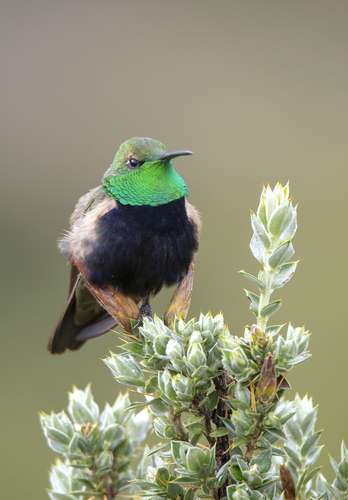 Black-breasted HillstarOreotrochilus melanogasterThe black-breasted hillstar is 13 to 14 cm (5.1 to 5.5 in) long and weighs about 8.4 g (0.30 oz).
Learn the Blue-throated Hillstar in the BeakBrain App
Photo and call practice. Coming soon to iPhone and Android.
Play today's Daily BirdEvery photo and recording on this page is credited to its author under the licence shown. Spotted a problem with this page, or have a better photo? Contribute.