Learn what every symbol on the card means.Full credits and sources at beakbrain.com/symbols
 WoodlandCavity nestSmall · 29 g


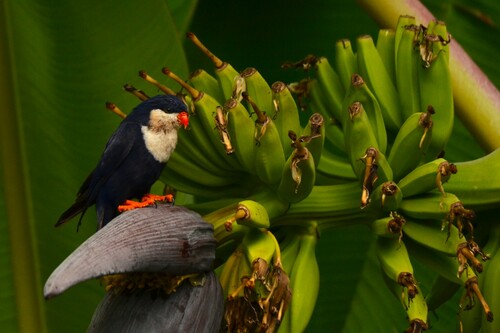
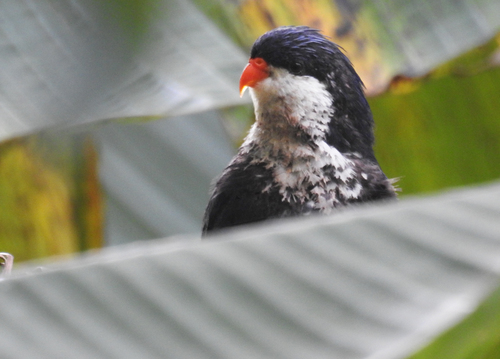
ID tip
The blue lorikeet is 18 cm long with a short rounded tail. Its plumage is mainly dark blue and it has a white area over its upper chest, throat and lower face. Erectile feathers on the top of its head show light blue streaks. Its beak is orange and its irises are yellow-brown. It has orange legs. Adult males and females have identical external appearance. The juvenile lacks the white plumage of the adult and has a dark grey-blue face and lower parts. The juvenile also has a black bill, dark brown irises, and its legs are orange brown.
Text from Wikipedia, licensed CC BY-SA 4.0.
When to see the Blue Lorikeet
One bar for each month. Filled bars are the 10 months with records; pale bars are months with none. The wide bar is October, the month with the most records.
Where to see the Blue Lorikeet
The map shades 2 countries with regular records. Everything unshaded has no records. Countries are listed below the map.
About the Blue Lorikeet
The blue lorikeet is a small lorikeet from French Polynesia and the Cook Islands. It is also known as the Tahiti lorikeet, violet lorikeet, Tahitian lory, blue lory, nunbird, and the indigo lory. It was formerly found on 23 islands around Tahiti, but is now restricted to perhaps eight islands: Aitutaki, Apataki, Arutua, Kaukura, Manuae, Maupihaa, Motu One, Rangiroa, and possibly Manihi and Manuae. Its plumage is mainly dark blue and it has a white area over its upper chest, throat and face. The first captive breeding in the UK was by the Marquess of Tavistock in the 1930s. He was awarded a silver medal by the Foreign Bird League for this achievement.
Text adapted from Wikipedia, licensed CC BY-SA 4.0.
Easily confused with
 Kuhl's LorikeetVini kuhliiIt is a fast flying lorikeet with vibrant plumage; a green back, wings and crown, a blue nape and legs and bright red undersides and cheeks.
Learn the Blue Lorikeet in the BeakBrain App
Photo and call practice. Coming soon to iPhone and Android.
Play today's Daily BirdEvery photo and recording on this page is credited to its author under the licence shown. Spotted a problem with this page, or have a better photo? Contribute.