Learn what every symbol on the card means.Full credits and sources at beakbrain.com/symbols
 ForestDomed nestTiny · 5 g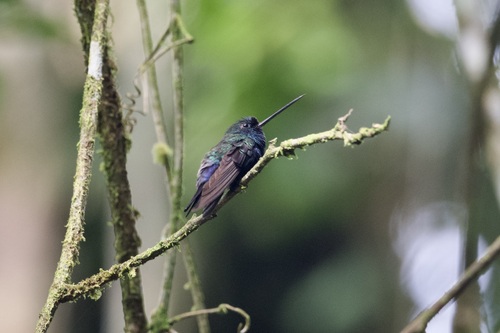


What the Blue-fronted Lancebill sounds like

ID tip
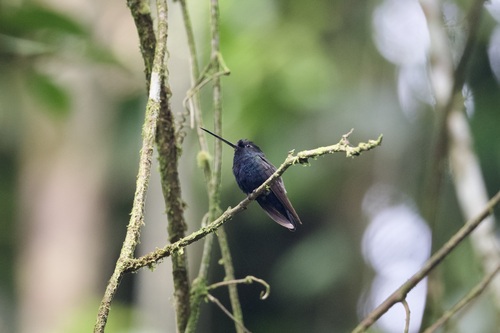
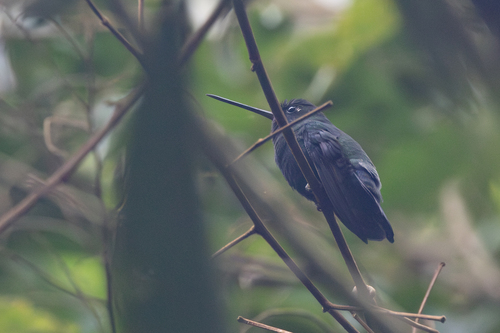
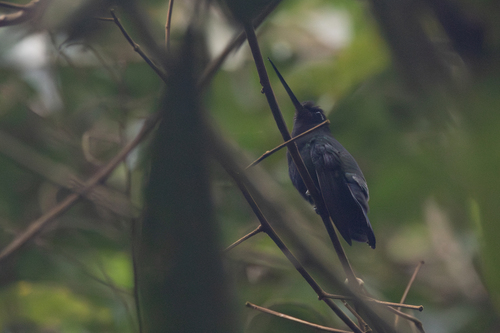
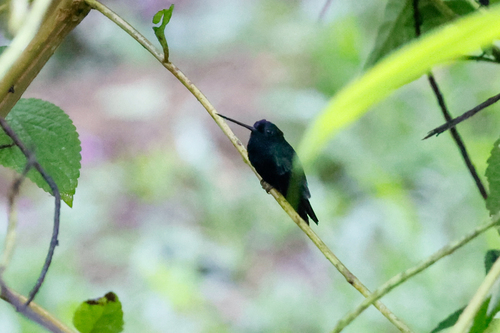
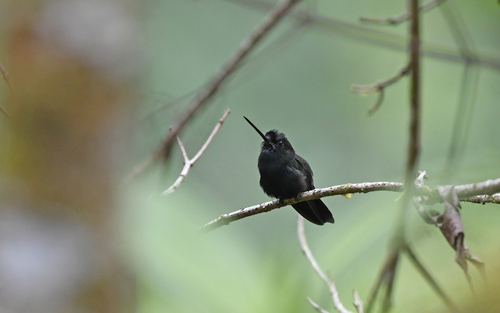
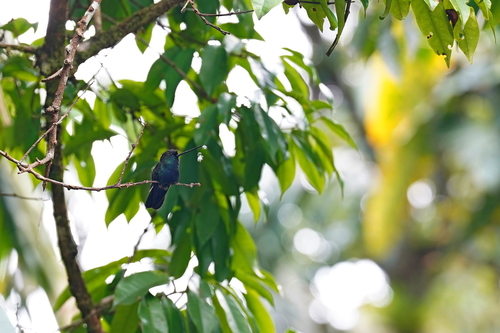
The blue-fronted lancebill is 9.6 to 11 cm (3.8 to 4.3 in) long. Males weigh 3 to 5 g (0.11 to 0.18 oz) and females 3.3 to 6 g (0.12 to 0.21 oz). Both sexes have a long straight to slightly upcurved bill, and often hold it at an upward angle. Males of the nominate subspecies have a violet forehead ("front"), a bronze nape, and otherwise dark bronzy green upperparts. The tail is short and blue-black. The underparts are blue-black with a bluish green gloss on the throat and breast. The female differs from the male by having a greenish blue forehead and dull grayish bronzy green underparts. Voice: The blue-fronted lancebill's song has not been described and apparently has not been recorded. While foraging it makes "thin, dry, chittering notes...e.g. 'chuert'."
Text from Wikipedia, licensed CC BY-SA 4.0.
When to see the Blue-fronted Lancebill
One bar for each month, and every month is filled: this bird is recorded here in all twelve. The wide bar is July, the month with the most records.
Where to see the Blue-fronted Lancebill
The map shades 5 countries with regular records, and 1 more in a lighter tone where the bird turns up only as a stray. Everything unshaded has no records. Countries are listed below the map.
Recorded as a rare visitor in Brazil.
About the Blue-fronted Lancebill
The blue-fronted lancebill is a species of hummingbird in the family Trochilidae. It is found in Brazil, Colombia, Ecuador, Guyana, Peru, and Venezuela.
Text adapted from Wikipedia, licensed CC BY-SA 4.0.
Easily confused with

Side by side: Blue-fronted Lancebill vs Green-fronted Lancebill
Learn the Blue-fronted Lancebill in the BeakBrain App
Photo and call practice. Coming soon to iPhone and Android.
Play today's Daily BirdEvery photo and recording on this page is credited to its author under the licence shown. Spotted a problem with this page, or have a better photo? Contribute.