Learn what every symbol on the card means.Full credits and sources at beakbrain.com/symbols
 ForestCavity nestSmall · 33 g


ID tip
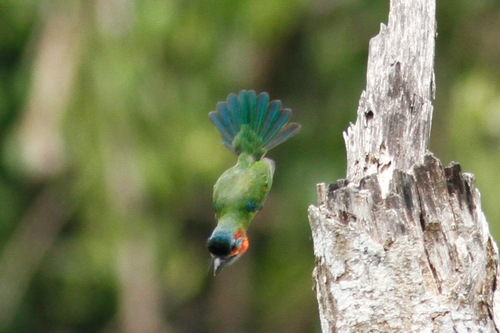
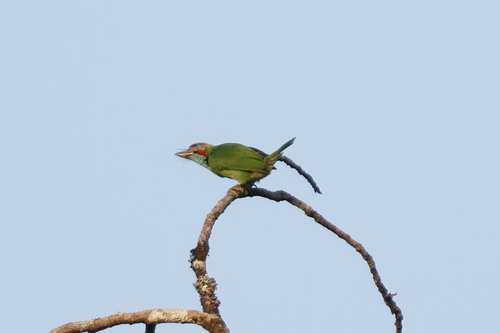
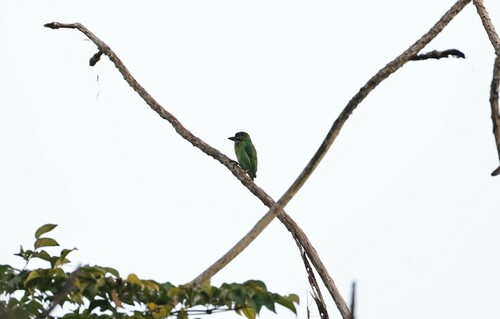
The blue-eared barbet has green plumage and crimson-coloured spots on the cheeks. Its throat and ear-coverts are verditer-blue. A black band runs between throat and breast. It is 16–17 cm (6.3–6.7 in) long. It is a plump bird, with a short neck, large head and short tail. The bill is dark. The adult male has a black forehead. The female has a duller head pattern with a more orange tint to the patches above and below the ear coverts, and the juvenile has a green head with some blue on the ear coverts and throat. The male's territorial call is a repeated loud ko-turr.
Text from Wikipedia, licensed CC BY-SA 4.0.
When to see the Blue-eared Barbet
One bar for each month. Filled bars are the 8 months with records; pale bars are months with none. The wide bar is March, the month with the most records.
Where to see the Blue-eared Barbet
The map shades 9 countries with regular records, and 2 more in a lighter tone where the bird turns up only as a stray. Everything unshaded has no records. Countries are listed below the map.
About the Blue-eared Barbet
The blue-eared barbet is a barbet in the Megalaimidae family native to mainland Southeast Asia. Because of its wide distribution and stable population it is listed as Least Concern on the IUCN Red List.
Text adapted from Wikipedia, licensed CC BY-SA 4.0.
Easily confused with
 Turquoise-throated BarbetPsilopogon chersonesusThe turquoise-throated barbet is an Asian barbet found in Thailand.
 Brown-throated BarbetPsilopogon corvinusThe brown-throated barbet is a species of bird in the family Megalaimidae.
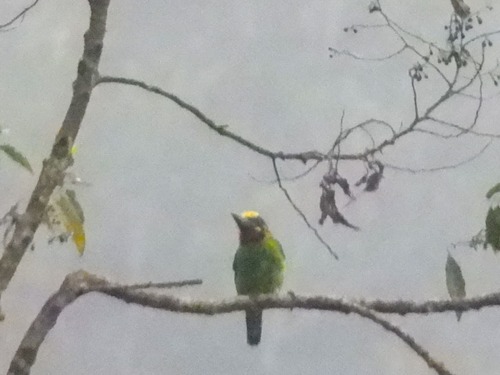 Black-banded BarbetPsilopogon javensisThe black-banded barbet is a bird species in the Megalaimidae family.
Learn the Blue-eared Barbet in the BeakBrain App
Photo and call practice. Coming soon to iPhone and Android.
Play today's Daily BirdEvery photo and recording on this page is credited to its author under the licence shown. Spotted a problem with this page, or have a better photo? Contribute.