Learn what every symbol on the card means.Full credits and sources at beakbrain.com/symbols
 ForestCup nestTiny · 13 g


ID tip
The blue dacnis is 12.7 cm long and weighs 13 g. Despite its alternative name, it is not a honeycreeper, which are longer-billed. The adult male is turquoise blue with a black around the eyes, and on the throat and back. The wings and tail are black, edged with turquoise. The female and immature are mainly green with a blue head, paler green underparts and green-edged brown wings. The blue dacnis's call is a thin tsip.
Text from Wikipedia, licensed CC BY-SA 4.0.
When to see the Blue Dacnis
One bar for each month, and every month is filled: this bird is recorded here in all twelve. The wide bar is October, the month with the most records.
Where to see the Blue Dacnis
The map shades 16 countries with regular records, and 1 more in a lighter tone where the bird turns up only as a stray. Everything unshaded has no records. Countries are listed below the map.
Recorded as a rare visitor in United States.
About the Blue Dacnis
The blue dacnis or turquoise honeycreeper is a small passerine bird. This member of the tanager family is found from Nicaragua to Panama, on Trinidad, and in South America south to Bolivia and northern Argentina. It is widespread and often common, especially in parts of its South American range.
Text adapted from Wikipedia, licensed CC BY-SA 4.0.
Easily confused with
 Scarlet-thighed DacnisDacnis venustaThe iris of the scarlet-thighed dacnis is bright red in male individuals, and duller red in the females.
 Black-faced DacnisDacnis lineataThe black-faced dacnis is a species of bird in the family Thraupidae.
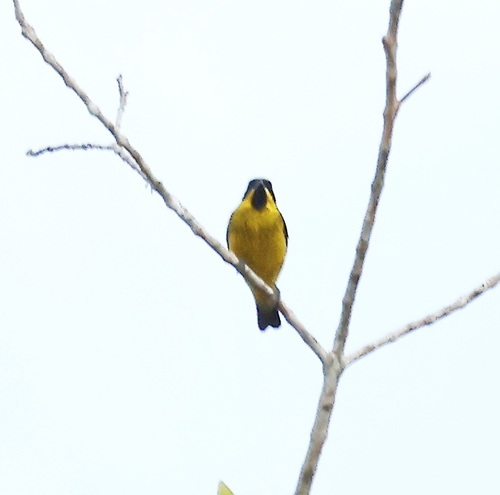 Yellow-bellied DacnisDacnis flaviventerThe yellow-bellied dacnis is a species of bird in the family Thraupidae, the Tanagers.
Side by side: Blue Dacnis vs Scarlet-thighed Dacnis
Learn the Blue Dacnis in the BeakBrain App
Photo and call practice. Coming soon to iPhone and Android.
Play today's Daily BirdEvery photo and recording on this page is credited to its author under the licence shown. Spotted a problem with this page, or have a better photo? Contribute.