Learn what every symbol on the card means.Full credits and sources at beakbrain.com/symbols
 WetlandCavity nestSmall · 23 g


ID tip
The blue-breasted bee-eater, Merops variegatus, exhibits several physically defining characteristics of the Meropidae. It has a relatively large head, short neck, bright plumage, long curved slim sharp beak and a broad black eyestripe. M. variegatus weights between 20 and 26 g and measures between 18 and 21 cm in length. It is primarily a green bird, with a green crown, green upper parts and light greenish-yellow underparts. Primary wings are washed with rufous and secondaries are green with black tips. Voice: The perching song for this species contains short trills: pip, tup-tup and trrip where as the courtship song to a mate is more expanded: turrp p'ti p'ti p'ti.
Text from Wikipedia, licensed CC BY-SA 4.0.
When to see the Blue-breasted Bee-eater
One bar for each month. Filled bars are the 11 months with records; pale bars are months with none. The wide bar is July, the month with the most records.
Where to see the Blue-breasted Bee-eater
The map shades 14 countries with regular records. Everything unshaded has no records. Countries are listed below the map.
About the Blue-breasted Bee-eater
The blue-breasted bee-eater is a central African species of bird. It is a member of the family Meropidae. Meropids are all visually similar and have a diet specialized in Hymenopterans.
Text adapted from Wikipedia, licensed CC BY-SA 4.0.
Easily confused with
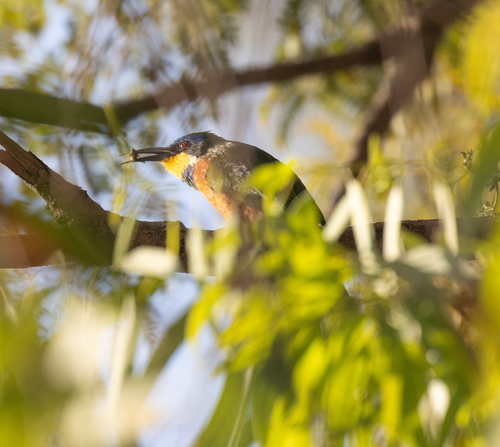 Ethiopian Bee-eaterMerops lafresnayiiAt around 21 cm long, it is slightly larger than blue-breasted bee-eater but similar in size to cinnamon-chested bee-eater, and generally similar to both in plumage.
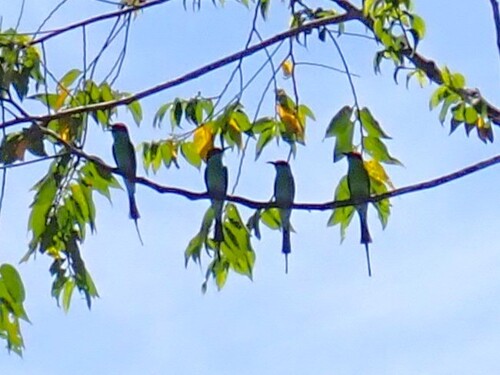 Rufous-crowned Bee-eaterMerops americanusThe rufous-crowned bee-eater is a species of bird in the family Meropidae.
 African Green Bee-eaterMerops viridissimusIt is 16–18 centimetres (6.3–7.1 in) long excluding the elongated central tail feathers, which are an additional 8–10 cm (3.1–3.9 in) long.
Learn the Blue-breasted Bee-eater in the BeakBrain App
Photo and call practice. Coming soon to iPhone and Android.
Play today's Daily BirdEvery photo and recording on this page is credited to its author under the licence shown. Spotted a problem with this page, or have a better photo? Contribute.