Learn what every symbol on the card means.Full credits and sources at beakbrain.com/symbols
 CoastalCavity nestMedium · 63 g



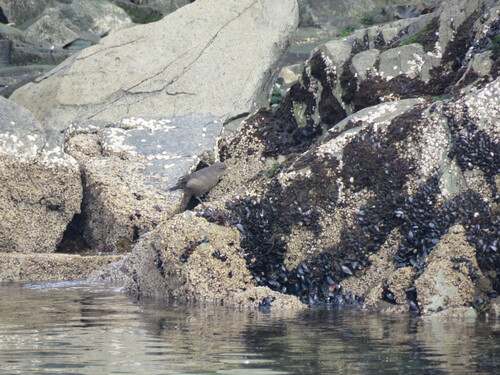


ID tip
The blackish cinclodes is 18 to 23 cm (7.1 to 9.1 in) long and weighs about 63 g (2.2 oz). The sexes have the same plumage. Adults of the nominate subspecies are mostly dark sooty brown, with a slightly paler throat and some dull rufous on the base of the flight feathers. The last is usually visible only in flight. Its iris is dark brown, its bill blackish, and its legs and feet blackish. Juveniles are generally browner than adults. Subspecies C. a. Voice: All of the recordings of blackish cinclodes vocalizations in xeno-canto and the Cornell Lab of Ornithology's Macaulay Library are from the Falkland Islands. The song is "a long series of sharp, explosive notes intermixed with musical trills...described as tittering chee-chee-chee-chee-cheecheecheecheecheechee-chee".
Text from Wikipedia, licensed CC BY-SA 4.0.
When to see the Blackish Cinclodes
One bar for each month. Filled bars are the 8 months with records; pale bars are months with none. The wide bar is November, the month with the most records.
Where to see the Blackish Cinclodes
The map shades 3 countries with regular records. Everything unshaded has no records. Countries are listed below the map.
About the Blackish Cinclodes
The blackish cinclodes is a Near Threatened passerine bird in the Furnariinae subfamily of the ovenbird family Furnariidae. It is found on Tierra del Fuego and the Falkland Islands, where it is known as the tussac-bird or tussock-bird.
Text adapted from Wikipedia, licensed CC BY-SA 4.0.
Easily confused with
 Peruvian Seaside CinclodesCinclodes taczanowskiiThe Peruvian seaside cinclodes is about 21 cm (8.3 in) long and weighs about 63 g (2.2 oz).
 Olrog's CinclodesCinclodes olrogiOlrog's cinclodes is about 17 cm (6.7 in) long and weighs 24 to 32 g (0.85 to 1.1 oz).
 Cordoba CinclodesCinclodes comechingonusThe Cordoba cinclodes is about 17 cm (6.7 in) long and weighs 25 to 32 g (0.88 to 1.1 oz).
Learn the Blackish Cinclodes in the BeakBrain App
Photo and call practice. Coming soon to iPhone and Android.
Play today's Daily BirdEvery photo and recording on this page is credited to its author under the licence shown. Spotted a problem with this page, or have a better photo? Contribute.