Learn what every symbol on the card means.Full credits and sources at beakbrain.com/symbols
 ShrublandCup nestTiny · 5 g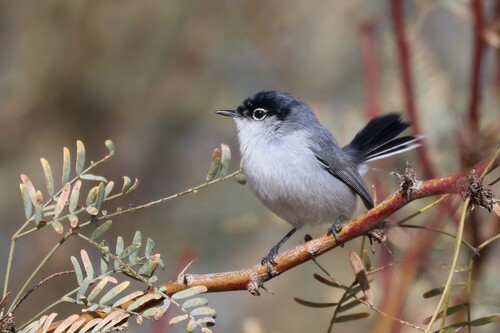


ID tip
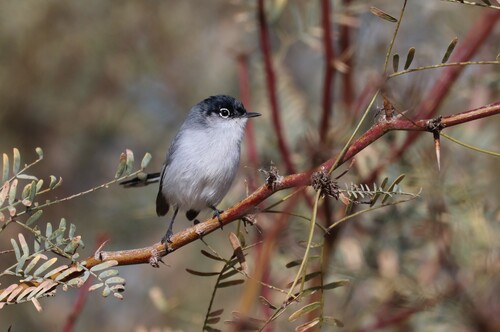
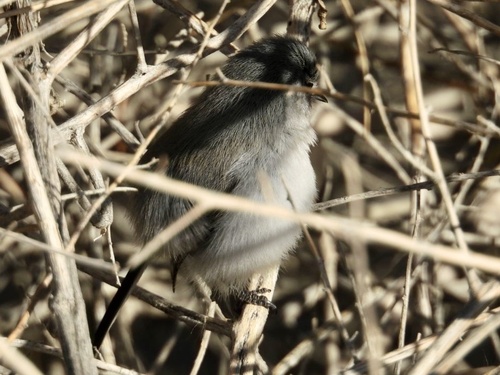
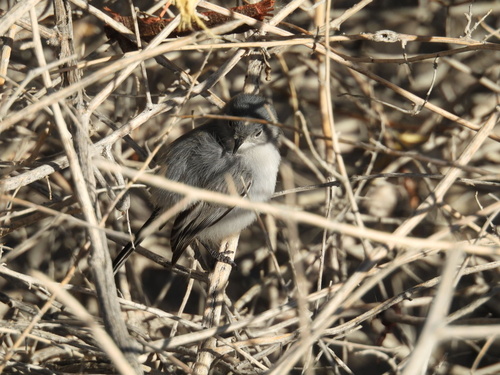
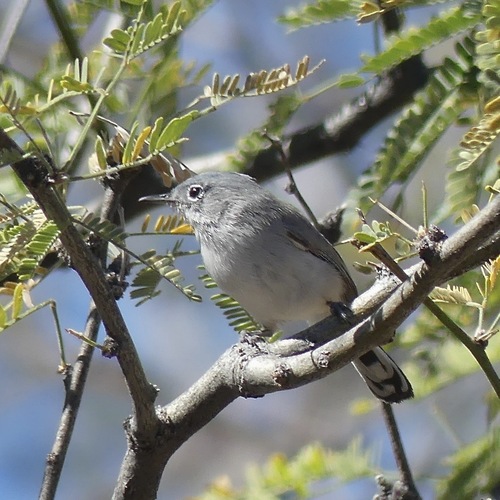
The black-tailed gnatcatcher reaches about 4.5 to 5 inches in length, much of it taken up by a long black tail lined with white outer feathers. The body is blue-grey, with white underparts, and while it is similar to the blue-grey gnatcatcher, the two birds are differentiated by the amount of black in the tail feathers. The male has a black cap during the summer that extends to the eyes. Females and winter males, lacking the black cap, are difficult to distinguish from the blue-grey gnatcatcher.
Text from Wikipedia, licensed CC BY-SA 4.0.
When to see the Black-tailed Gnatcatcher
One bar for each month, and every month is filled: this bird is recorded here in all twelve. The wide bar is March, the month with the most records.
Where to see the Black-tailed Gnatcatcher
The map shades 2 countries with regular records. Everything unshaded has no records. Countries are listed below the map.
About the Black-tailed Gnatcatcher
The black-tailed gnatcatcher is a small, insectivorous bird which ranges throughout the Sonoran and Chihuahuan Deserts of the southwestern United States and northern Mexico. It is nonmigratory and found in arid desert areas year-round.
Text adapted from Wikipedia, licensed CC BY-SA 4.0.
Easily confused with
 Tropical GnatcatcherPolioptila plumbeaThe adult tropical gnatcatcher is 10 to 12 cm (3.9–4.7 in) long, and weighs 6 to 8 g (0.21–0.28 oz).
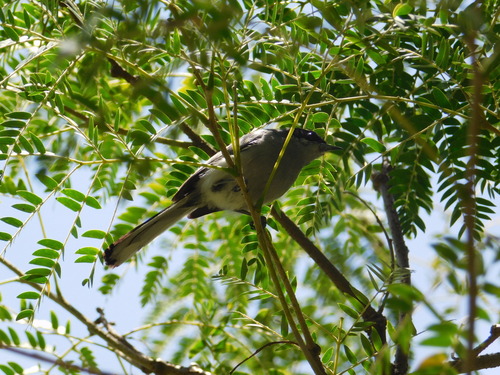 Masked GnatcatcherPolioptila dumicolaThe masked gnatcatcher is 12 to 13 cm (4.7 to 5.1 in) long and weighs 5 to 7 g (0.18 to 0.25 oz), larger than most other gnatcatchers.
 California GnatcatcherPolioptila californicaThe male California gnatcatcher is dusky gray overall, distinguished only by its black crown and thin black beak.
Side by side: Black-tailed Gnatcatcher vs Blue-grey Gnatcatcher · Black-tailed Gnatcatcher vs Tropical Gnatcatcher · Black-tailed Gnatcatcher vs Masked Gnatcatcher · Black-tailed Gnatcatcher vs California Gnatcatcher
Learn the Black-tailed Gnatcatcher in the BeakBrain App
Photo and call practice. Coming soon to iPhone and Android.
Play today's Daily BirdEvery photo and recording on this page is credited to its author under the licence shown. Spotted a problem with this page, or have a better photo? Contribute.