Learn what every symbol on the card means.Full credits and sources at beakbrain.com/symbols
 ForestCup nestSmall · 19 g
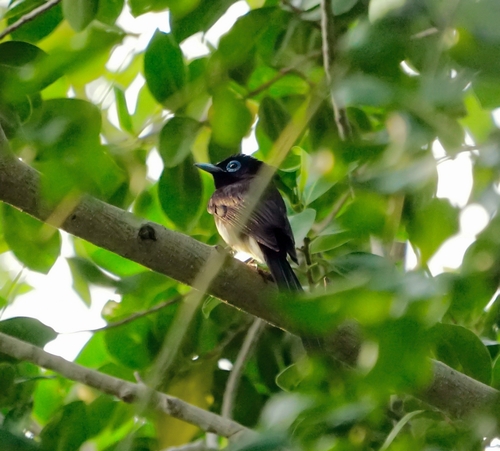
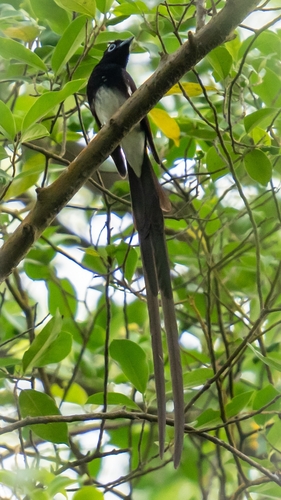
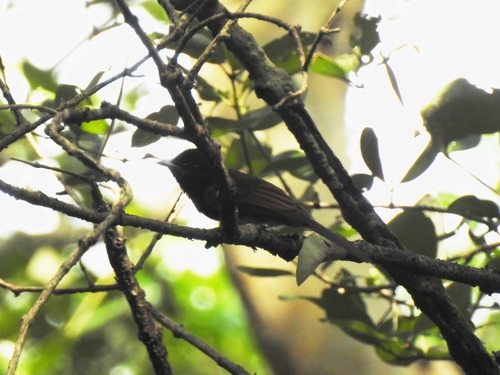
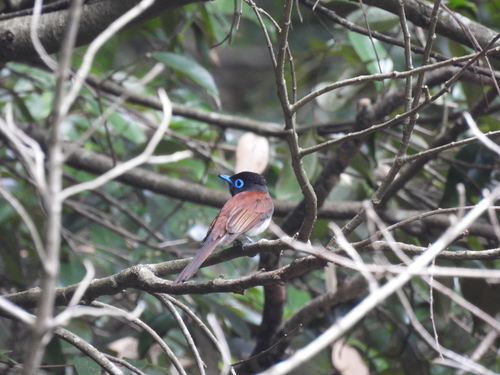
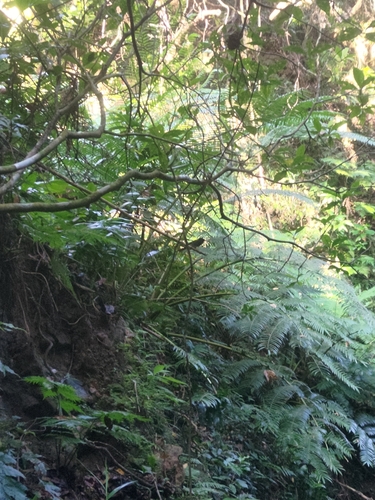
ID tip
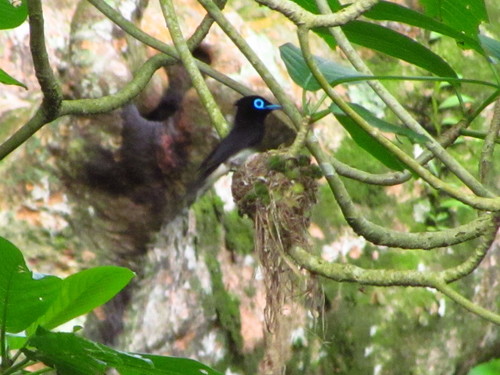
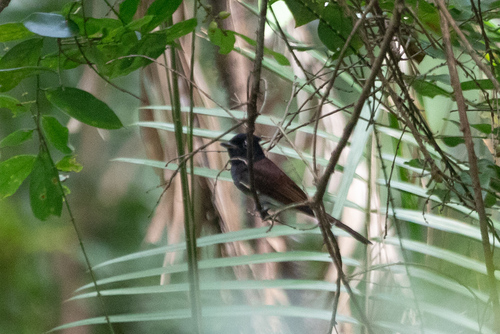
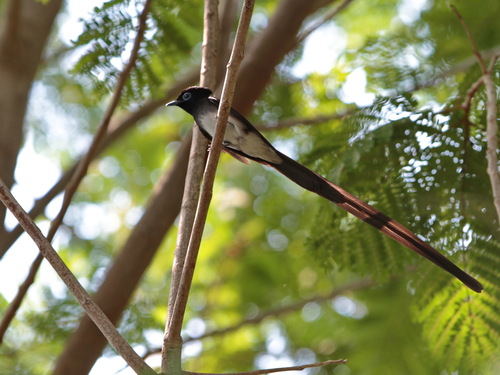
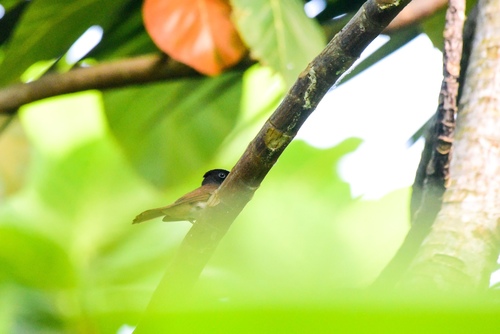
The black paradise flycatcher is similar in appearance to both the Amur paradise flycatcher and Blyth's paradise flycatcher, but is slightly smaller. Mature males have a black hood with a purplish-blue gloss which shades into blackish-grey on the chest. The underparts are off-white to white. The mantle, back, wings and rump are plain dark chestnut. The tail has extremely long black central feathers, which are shorter in immature males. Unlike the Asian paradise flycatcher there is no white morph. The female resembles the male but is duller and darker brown on the chestnut areas.
Text from Wikipedia, licensed CC BY-SA 4.0.
When to see the Black Paradise Flycatcher
One bar for each month. Filled bars are the 6 months with records; pale bars are months with none. The wide bar is April, the month with the most records.
Where to see the Black Paradise Flycatcher
The map shades 13 countries with regular records, and 1 more in a lighter tone where the bird turns up only as a stray. Everything unshaded has no records. Countries are listed below the map.
Recorded as a rare visitor in Mongolia.
About the Black Paradise Flycatcher
The black paradise flycatcher, also known as the Japanese paradise flycatcher, is a medium-sized passerine bird native to southeastern Asia. It is a glossy black, chestnut and white bird, slightly smaller than either the Amur paradise flycatcher or Blyth's paradise flycatcher, but similar in appearance. Males have exceptionally long tails. Females are generally duller in appearance and have shorter tails.
Text adapted from Wikipedia, licensed CC BY-SA 4.0.
Easily confused with
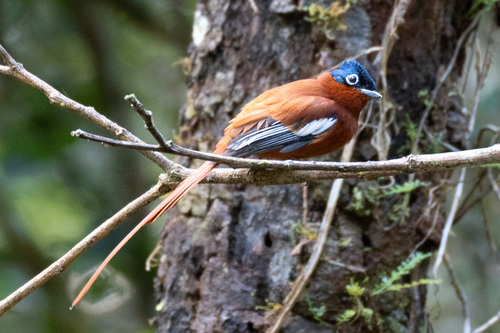 Malagasy Paradise FlycatcherTerpsiphone mutataThe Malagasy paradise flycatcher is a medium-sized passerine, measuring 18 cm (7.1 in) in length and weighing between 12.1 and 12.3 g (0.43 and 0.43 oz).
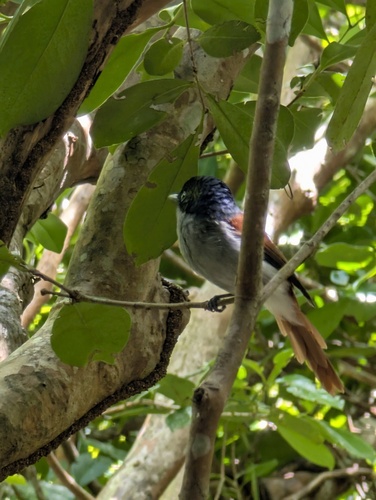 Mascarene Paradise FlycatcherTerpsiphone bourbonnensisThe Mascarene paradise flycatcher lacks the long tail shared by many members of the paradise flycatcher genus Terpsiphone, and measures 15 to 20 cm (5.9–7.9 in) in length.
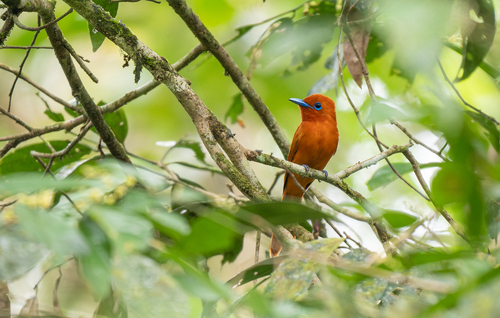 Rufous Paradise FlycatcherTerpsiphone cinnamomeaThe rufous paradise flycatcher is rufous with a blue bill and a blue eye-ring.
Side by side: Black Paradise Flycatcher vs Malagasy Paradise Flycatcher
Learn the Black Paradise Flycatcher in the BeakBrain App
Photo and call practice. Coming soon to iPhone and Android.
Play today's Daily BirdEvery photo and recording on this page is credited to its author under the licence shown. Spotted a problem with this page, or have a better photo? Contribute.