Learn what every symbol on the card means.Full credits and sources at beakbrain.com/symbols
 ForestCup nestTiny · 7 g


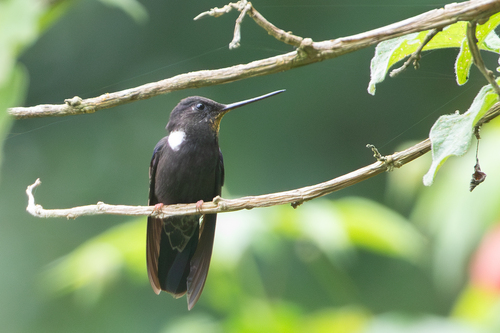
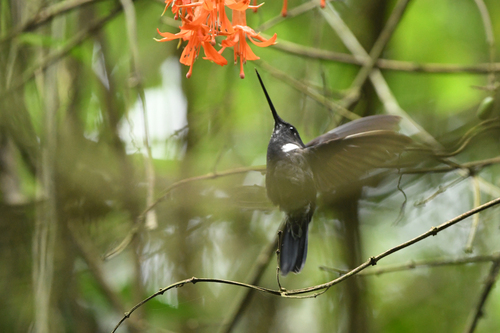
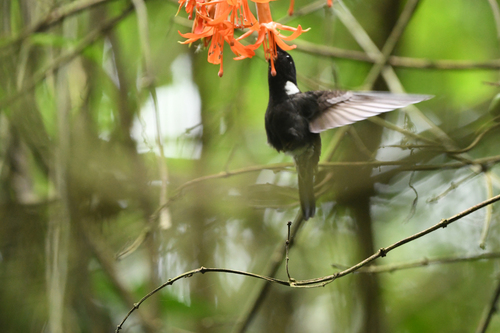


ID tip
The black inca is about 14 cm (5.5 in) long and weighs about 6.6 to 7.0 g (0.23 to 0.25 oz). Both sexes have a long, straight, black bill and a white spot behind the eye. Adult males' upperparts are purplish black with dark metallic blue shoulders and a black forked tail. Their underparts are also dark purplish black with an iridescent blue-green gorget and a white patch on each side of the breast. Adult females are essentially the same as males but duller, with a longer bill, less blue on the shoulders, and a less forked tail. Immatures are duller than the adults and do not have a gorget. Voice: The black inca is generally quiet but does produce short ick or pip notes.
Text from Wikipedia, licensed CC BY-SA 4.0.
When to see the Black Inca
One bar for each month. Filled bars are the 11 months with records; pale bars are months with none. The wide bar is October, the month with the most records.
Where to see the Black Inca
The map shades 1 country with regular records. Everything unshaded has no records. Countries are listed below the map.
About the Black Inca
The black inca is a species of hummingbird in the "brilliants", tribe Heliantheini in subfamily Lesbiinae. It is endemic to Colombia.
Text adapted from Wikipedia, licensed CC BY-SA 4.0.
Easily confused with
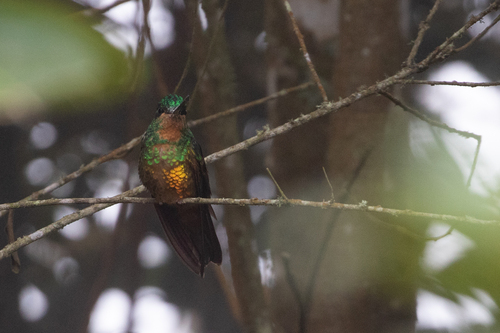 Golden-bellied StarfrontletCoeligena bonaparteiThe golden-bellied starfrontlet is about 10.9 cm (4.3 in) long including its 3.0 cm (1.2 in) bill.
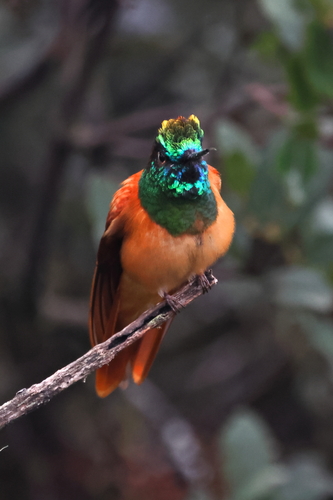 Rainbow StarfrontletCoeligena irisThe rainbow starfrontlet is 12.5 to 14 cm (4.9 to 5.5 in) long.
 Blue-throated StarfrontletCoeligena heliantheaThe blue-throated starfrontlet is about 13 cm (5.1 in) long.
Learn the Black Inca in the BeakBrain App
Photo and call practice. Coming soon to iPhone and Android.
Play today's Daily BirdEvery photo and recording on this page is credited to its author under the licence shown. Spotted a problem with this page, or have a better photo? Contribute.