Learn what every symbol on the card means.Full credits and sources at beakbrain.com/symbols
 ForestLarge · 730 g
ID tip
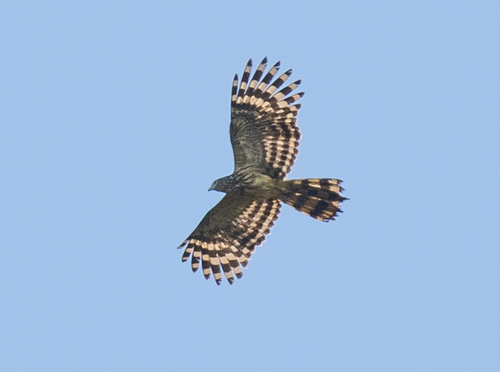
The black honey buzzard is a dark grey-brown colour with pale silvery bars on the wings and tail. When perched, the wing and tail bars are clearly visible. In flight, the wing bars are notable and the wing shape is distinctive, with a narrow base and broad tips, and bulging outer primaries. Juvenile markings are unknown. Its height ranges 48–52 cm (19–20 in), and wingspan ranges 110–115 cm (43–45 in). It was first identified and catalogued among European natural historians by James Sligo Jameson in 1877. Voice: Its vocalizations consist of 12 piping notes, accelerating and shortening over about three seconds.
Text from Wikipedia, licensed CC BY-SA 4.0.
When to see the Black Honey Buzzard
One bar for each month. Filled bars are the 7 months with records; pale bars are months with none. The wide bar is July, the month with the most records.
Where to see the Black Honey Buzzard
The map shades 1 country with regular records. Everything unshaded has no records. Countries are listed below the map.
About the Black Honey Buzzard
The black honey buzzard, also known as the New Britain honey buzzard, is a large raptor of the family Accipitridae. Standing at around 50 cm (20 in) tall, the adult black honey buzzard has a dark head and body, with striking white bands on its tail and flight feathers. When in flight, the buzzard can be recognized by its long wings and noticeably large secondary feathers. It is thought to be sedentary, with a range limited to the island of New Britain in Papua New Guinea, where it is endemic. Due to its remote habitat and tendency to remain in densely forested areas, there is still much to learn about this striking species.
Text adapted from Wikipedia, licensed CC BY-SA 4.0.
Easily confused with
Learn the Black Honey Buzzard in the BeakBrain App
Photo and call practice. Coming soon to iPhone and Android.
Play today's Daily BirdEvery photo and recording on this page is credited to its author under the licence shown. Spotted a problem with this page, or have a better photo? Contribute.