Learn what every symbol on the card means.Full credits and sources at beakbrain.com/symbols
 ForestDomed nestTiny · 7 g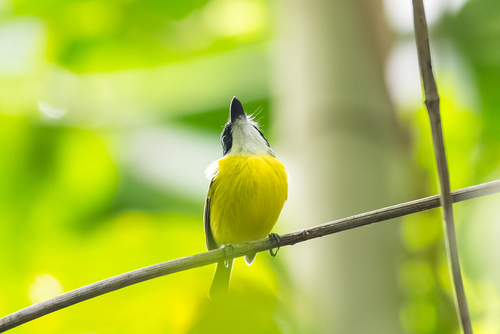
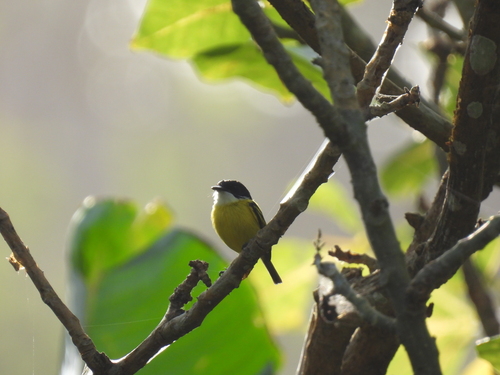
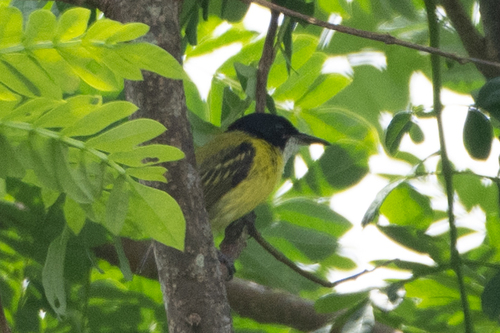
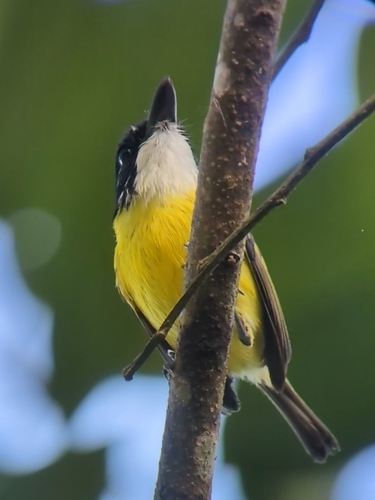
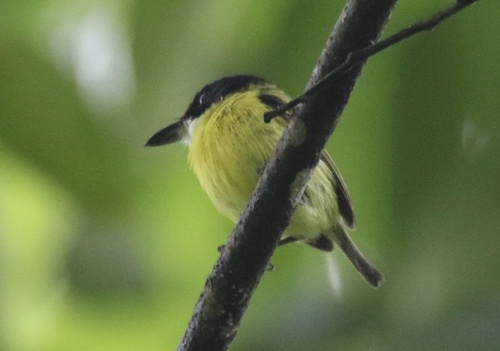
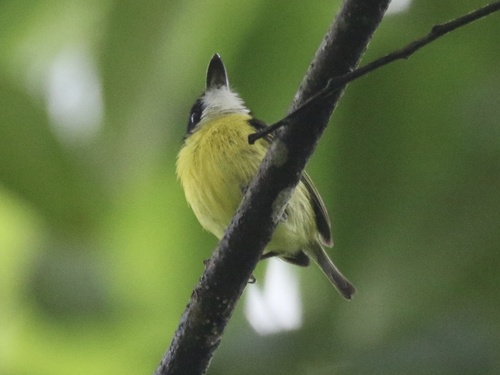

What the Black-headed Tody-Flycatcher sounds like

ID tip
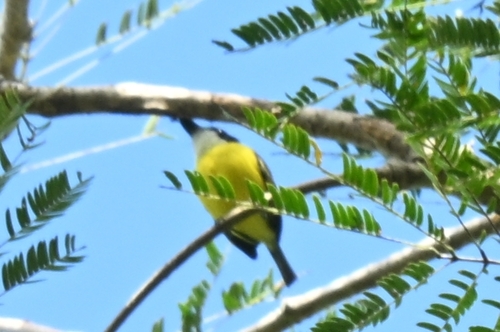
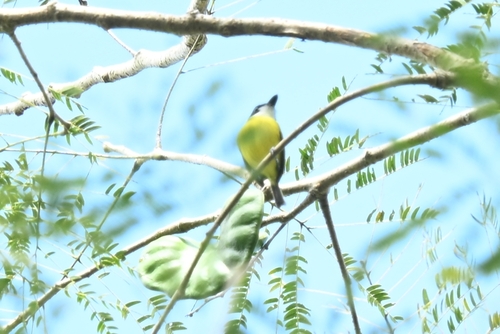
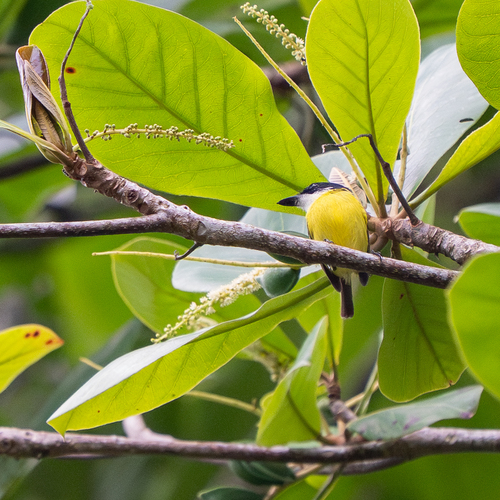
The black-headed tody flycatcher is a small bird with a glossy black head and a white throat. The black coloring continues down the sides of the neck. It has bright yellow underparts and olive-yellow upperparts. The wings are black with two yellow wingbars and yellow streaking and the tail is short and black. Its head is relatively large, as is its straight black bill. It has dark irises and no eye-rings. Its legs are blueish-gray. The females and males have the same coloring. Adults are between 8–10.2 cm long and weigh 6–6.5 g. Voice: This species' call is a single high-pitched "peep". Its song is a series of 5 to 8 high-pitched "jyip" notes that are quickly repeated. They start evenly spaced and accelerate slightly at the end, increasing in pitch slightly. It often calls repeatedly, which can be easily confused with their song. The chirps also sound insect-like. Listen to the call Listen to the song
Text from Wikipedia, licensed CC BY-SA 4.0.
When to see the Black-headed Tody-Flycatcher
One bar for each month, and every month is filled: this bird is recorded here in all twelve. The wide bar is March, the month with the most records.
Where to see the Black-headed Tody-Flycatcher
The map shades 6 countries with regular records, and 1 more in a lighter tone where the bird turns up only as a stray. Everything unshaded has no records. Countries are listed below the map.
Recorded as a rare visitor in Honduras.
About the Black-headed Tody-Flycatcher
The black-headed tody-flycatcher is a species of bird in the family Tyrannidae. It is found in Colombia, Costa Rica, Ecuador, Panama, and Venezuela. Its natural habitat is subtropical or tropical moist lowland forests. It is a small, black and yellow, insectivorous bird.
Text adapted from Wikipedia, licensed CC BY-SA 4.0.
Easily confused with
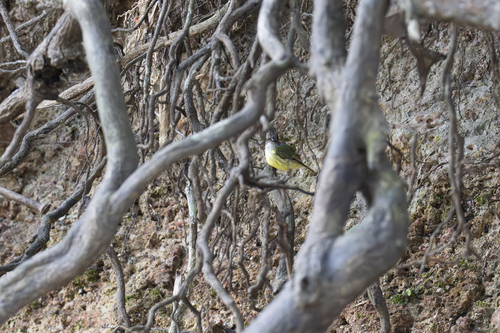 Spotted Tody-FlycatcherTodirostrum maculatumThe spotted tody-flycatcher is 8.9 to 10.2 cm (3.5 to 4.0 in) long and weighs 6.4 to 8.3 g (0.23 to 0.29 oz).
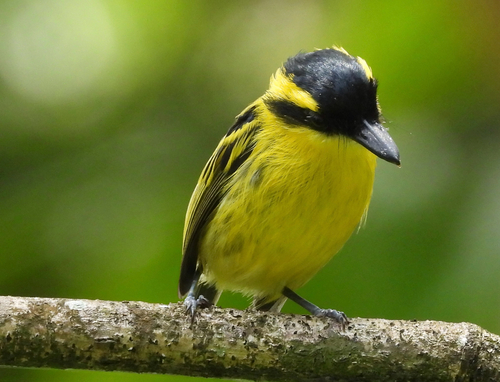 Yellow-browed Tody-FlycatcherTodirostrum chrysocrotaphumThe yellow-browed tody-flycatcher is 8.6 to 10 cm (3.4 to 3.9 in) long and weighs about 7 g (0.25 oz).
 Yellow-lored Tody-FlycatcherTodirostrum poliocephalumThe yellow-lored tody-flycatcher is 8.8 to 10.2 cm (3.5 to 4.0 in) long and weighs about 5 to 6 g (0.18 to 0.21 oz).
Side by side: Black-headed Tody-Flycatcher vs Common Tody-Flycatcher · Black-headed Tody-Flycatcher vs Yellow-lored Tody-Flycatcher · Black-headed Tody-Flycatcher vs Spotted Tody-Flycatcher · Black-headed Tody-Flycatcher vs Yellow-browed Tody-Flycatcher
Learn the Black-headed Tody-Flycatcher in the BeakBrain App
Photo and call practice. Coming soon to iPhone and Android.
Play today's Daily BirdEvery photo and recording on this page is credited to its author under the licence shown. Spotted a problem with this page, or have a better photo? Contribute.