Learn what every symbol on the card means.Full credits and sources at beakbrain.com/symbols
 ForestCavity nestMedium · 81 g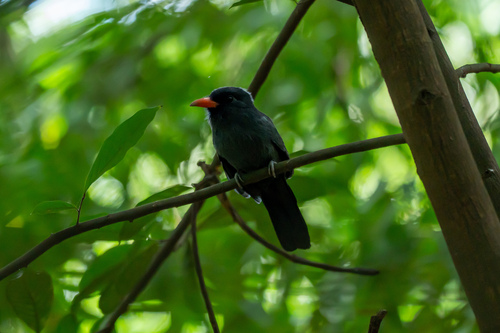
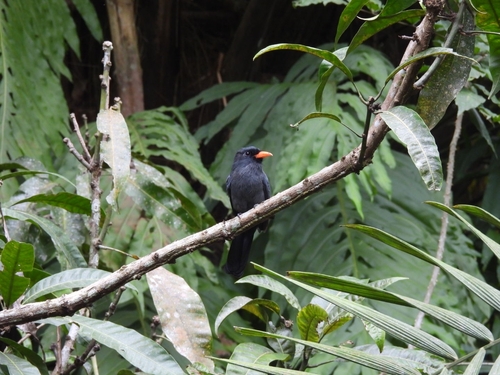

ID tip
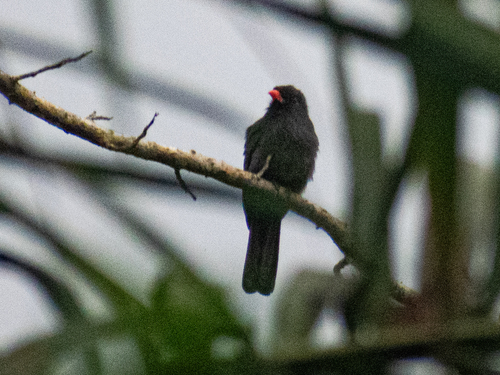
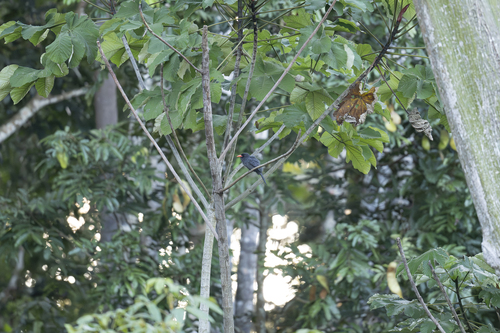
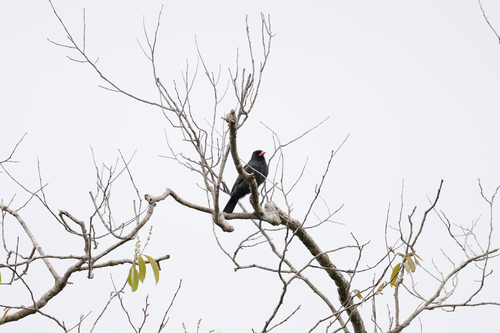
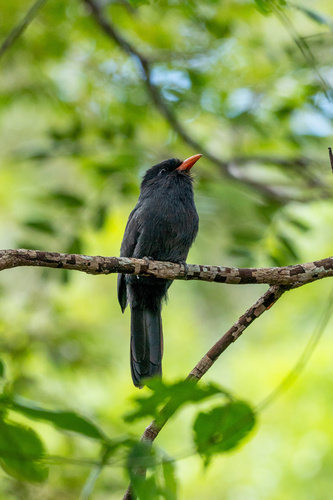
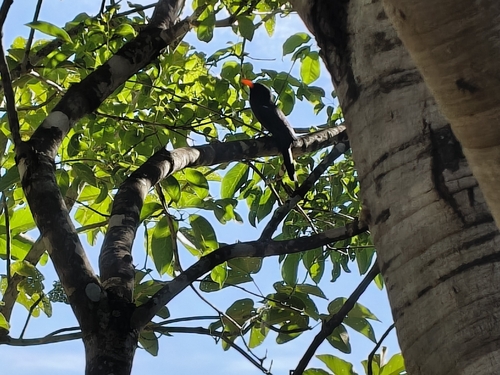
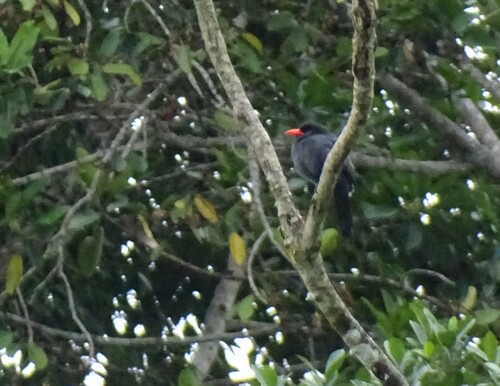
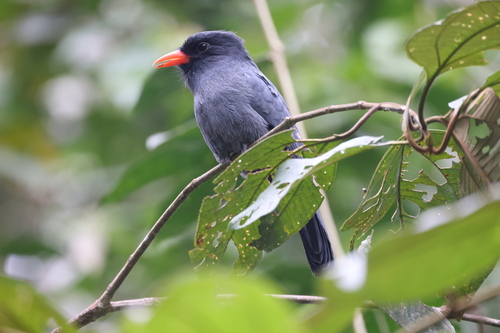
The black-fronted nunbird is 26 to 29 cm (10 to 11 in) long and weighs 68 to 98 g (2.4 to 3.5 oz). The adult of the nominate subspecies is mostly sooty black that is darkest around the bill (the "front"). The rear part of the body is blue-gray and the tail blue-black. The bill is red, the eye dark, and the legs black. M. n. canescens is slightly paler and grayer than the nominate. The juvenile of both is a dirty slate gray with irregular reddish marks. Voice: The black-fronted nunbird's song is " a rapid series of melodious upslurred 'clerry' or 'curry' whistles, broken by occasional downslurred 'turra turra' trill". It is often sung as a chorus by several birds.
Text from Wikipedia, licensed CC BY-SA 4.0.
When to see the Black-fronted Nunbird
One bar for each month, and every month is filled: this bird is recorded here in all twelve. The wide bar is July, the month with the most records.
Where to see the Black-fronted Nunbird
The map shades 5 countries with regular records, and 1 more in a lighter tone where the bird turns up only as a stray. Everything unshaded has no records. Countries are listed below the map.
Recorded as a rare visitor in Venezuela.
About the Black-fronted Nunbird
The black-fronted nunbird is a species of near-passerine bird in the family Bucconidae, the puffbirds, nunlets, and nunbirds. It is found in Bolivia, Brazil, Colombia, Ecuador, and Peru.
Text adapted from Wikipedia, licensed CC BY-SA 4.0.
Easily confused with
 White-fronted NunbirdMonasa morphoeusThe white-fronted nunbird is 21 to 29 cm (8.3 to 11 in) long.
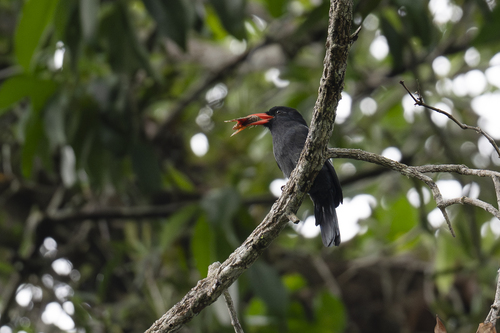 Black NunbirdMonasa atraThe black nunbird is 25 to 29 cm (9.8 to 11 in) long and weighs 74 to 104 g (2.6 to 3.7 oz).
 Yellow-billed NunbirdMonasa flavirostrisThe yellow-billed nunbird is 23 to 25 cm (9.1 to 9.8 in) long and weighs about 39 g (1.4 oz).
Side by side: Black-fronted Nunbird vs Swallow-winged Puffbird · Black-fronted Nunbird vs White-fronted Nunbird · Black-fronted Nunbird vs Black Nunbird · Black-fronted Nunbird vs Yellow-billed Nunbird
Learn the Black-fronted Nunbird in the BeakBrain App
Photo and call practice. Coming soon to iPhone and Android.
Play today's Daily BirdEvery photo and recording on this page is credited to its author under the licence shown. Spotted a problem with this page, or have a better photo? Contribute.