Learn what every symbol on the card means.Full credits and sources at beakbrain.com/symbols
 ForestSmall · 22 g


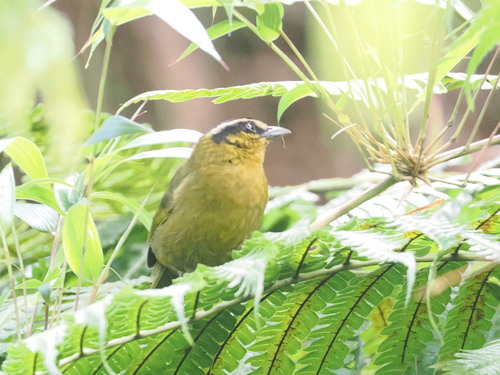
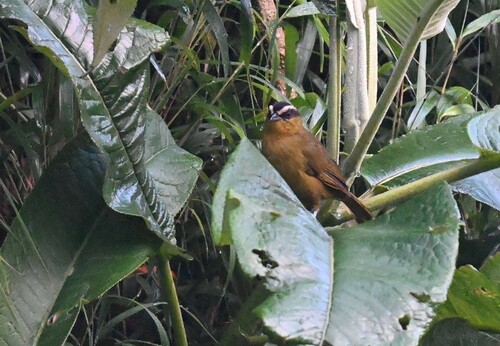
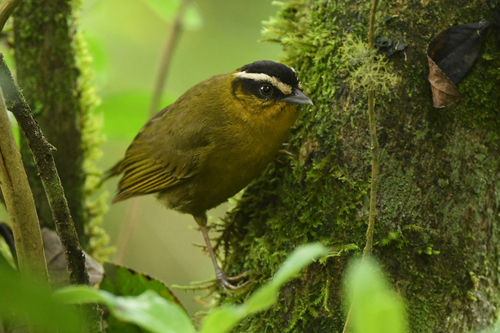
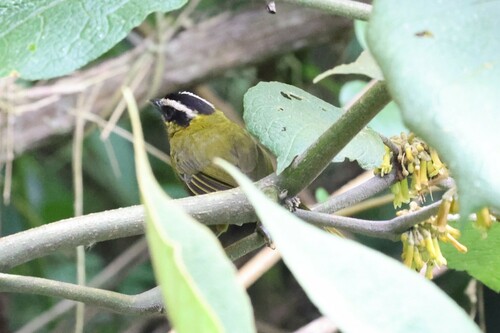
What the Black-capped Hemispingus sounds like


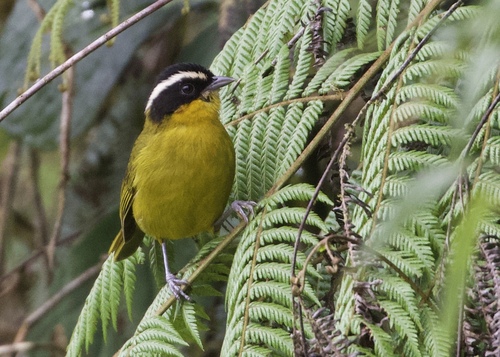
ID tip
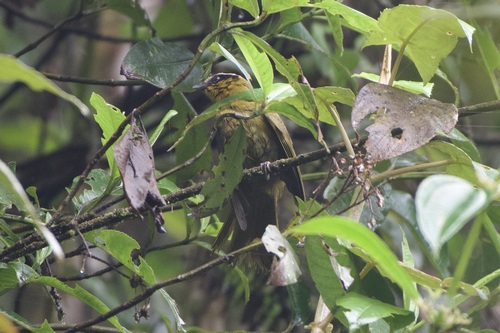
The black-capped hemispingus is, on average, 15–16 cm (5.9–6.3 in) long and weighs 18–26 g (0.6–0.9 oz). It has olive-brown upperparts, and largely olive to olive-yellow underparts. The throat is ochreous-yellow, grading to a yellow-olive towards the underparts. The sides and top of the head are pure black, with a buff-and-white supercilium that stretches to the back of the neck. Although the black-capped hemispingus is confusable with the closely-related orange-browed hemispingus, these two species do not co-occur anywhere in their ranges.
Text from Wikipedia, licensed CC BY-SA 4.0.
When to see the Black-capped Hemispingus
One bar for each month, and every month is filled: this bird is recorded here in all twelve. The wide bar is November, the month with the most records.
Where to see the Black-capped Hemispingus
The map shades 4 countries with regular records. Everything unshaded has no records. Countries are listed below the map.
About the Black-capped Hemispingus
The black-capped hemispingus is a species of bird in the family Thraupidae. It is found in the Andes mountains of Colombia, Ecuador, Venezuela and Peru. Its natural habitat is subtropical or tropical moist montane forests.
Text adapted from Wikipedia, licensed CC BY-SA 4.0.
Easily confused with
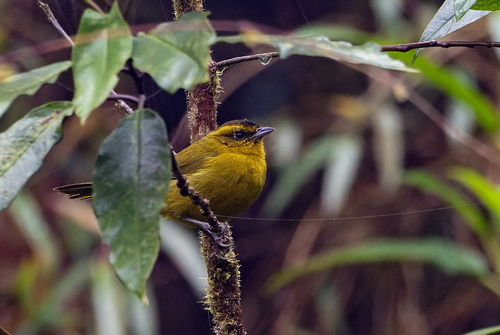 Parodi's HemispingusKleinothraupis parodiiParodi's hemispingus is a species of bird in the family Thraupidae, endemic to Peru.
 Orange-browed HemispingusKleinothraupis calophrysThe orange-browed hemispingus is, on average, 14–16 cm (5.5–6.3 in) long and weighs 14.5–20.5 g (0.5–0.7 oz).
Grey-capped HemispingusKleinothraupis reyiThe species has a grey crown and does not have any supercilium.
Orange-browed HemispingusKleinothraupis calophrysThe orange-browed hemispingus is, on average, 14–16 cm (5.5–6.3 in) long and weighs 14.5–20.5 g (0.5–0.7 oz).
Grey-capped HemispingusKleinothraupis reyiThe species has a grey crown and does not have any supercilium.
Learn the Black-capped Hemispingus in the BeakBrain App
Photo and call practice. Coming soon to iPhone and Android.
Play today's Daily BirdEvery photo and recording on this page is credited to its author under the licence shown. Spotted a problem with this page, or have a better photo? Contribute.