Learn what every symbol on the card means.Full credits and sources at beakbrain.com/symbols
 GrasslandCup nestSmall · 26 g


ID tip
The bird is more or less brown all over, with an extensive black area on upper breast and uniform rufous-buff remainder of underparts. The similar spot-breasted parrotbill, a close relative, has arrow-shaped spotting on breast and pale buff underparts. The voice is a gruff howh, jeehw or jahw, the song a rhythmic series, aw jahw jahw jahw and uhwi uhwi uhwi uhwi. Alternatively, a higher-pitched wi chi'chi'chi'chi'chi, wi yi'yi'yi'yi'yi; wi'uwi-uwi-uwi wi chu-chu-chu is given.
Text from Wikipedia, licensed CC BY-SA 4.0.
When to see the Black-breasted Parrotbill
One bar for each month. Filled bars are the 8 months with records; pale bars are months with none. The wide bar is April, the month with the most records.
Where to see the Black-breasted Parrotbill
The map shades 1 country with regular records. Everything unshaded has no records. Countries are listed below the map.
About the Black-breasted Parrotbill
The black-breasted parrotbill is a 19 cm (7.5 in) long, large, thick-billed parrotbill with black patches on the head-sides and throat. Formerly placed in the family Sylviidae, the parrotbills are now considered a distinct family, the Paradoxornithidae, following Cai et al. (2019).
Text adapted from Wikipedia, licensed CC BY-SA 4.0.
Easily confused with
 Great ParrotbillParadoxornis aemodiusThe great parrotbill is a bird species the Paradoxornithidae family.
 Rufous-headed ParrotbillParadoxornis bakeriThe rufous-headed parrotbill, or greater rufous-headed parrotbill, is a parrotbill in the family Paradoxornithidae and is found in eastern Asia from the eastern Himalayas to Indochina.
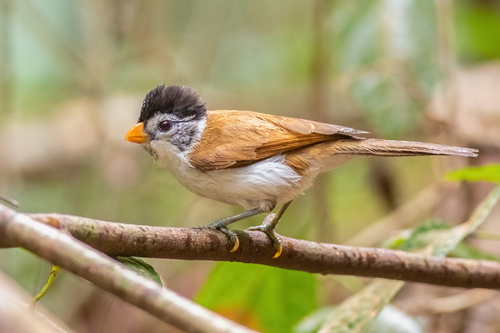 Black-headed ParrotbillParadoxornis margaritaeThe black-headed parrotbill is a bird species often placed with the Old World babblers or in the Sylviidae, but it actually seems to belong to the distinct family Paradoxornithidae.
Learn the Black-breasted Parrotbill in the BeakBrain App
Photo and call practice. Coming soon to iPhone and Android.
Play today's Daily BirdEvery photo and recording on this page is credited to its author under the licence shown. Spotted a problem with this page, or have a better photo? Contribute.