Learn what every symbol on the card means.Full credits and sources at beakbrain.com/symbols
 ForestScrapeHuge · 2.8 kg


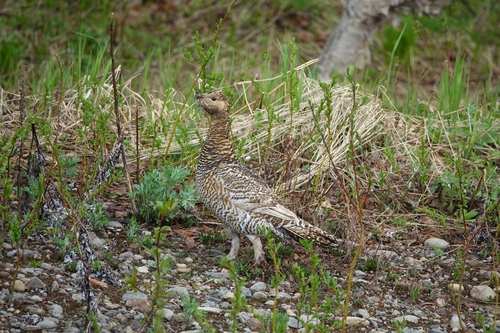
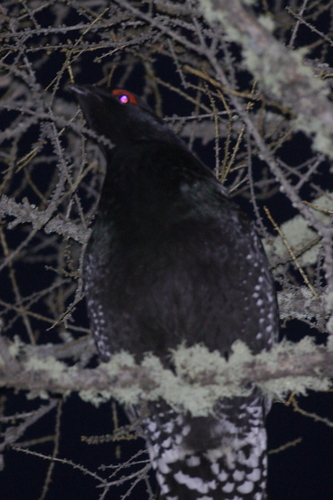
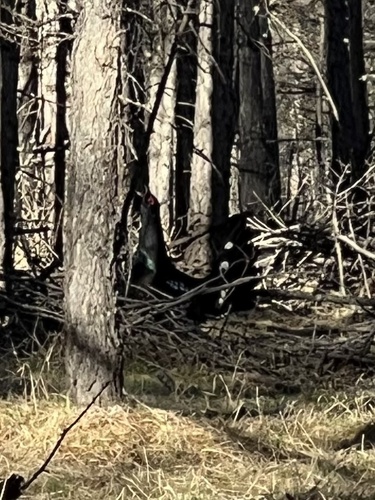


ID tip
A male black-billed capercaillie has an average length of about 89–97 cm (35–38 in) and weighs 3.4–4.6 kg (7.5–10.1 lb), with females measuring around 69–75 cm (27–30 in) and weighing 1.7–2.2 kg (3.7–4.9 lb). Their wingspan stretches approximately 75–115 cm (30–45 in) long. Compared to the western capercaillie, it is slightly smaller in size with a slimmer body profile and longer neck, has a black beak (hence its name) instead of being horn-colored, and a longer, more spatulate tail. The eastern capercaillie has a somewhat glossy bluish-black head and neck down to a metallic turquoise breast.
Text from Wikipedia, licensed CC BY-SA 4.0.
When to see the Black-billed Capercaillie
One bar for each month. Filled bars are the 8 months with records; pale bars are months with none. The wide bar is June, the month with the most records.
Where to see the Black-billed Capercaillie
The map shades 3 countries with regular records. Everything unshaded has no records. Countries are listed below the map.
About the Black-billed Capercaillie
The black-billed capercaillie is a large grouse species closely related to the more widespread western capercaillie. It is a sedentary species that breeds in the larch taiga forests of eastern Siberia as well as parts of northern Mongolia and China. In the far west of its distribution, the black-billed capercaillie has been known to hybridize with the western capercaillie. Compared to its western cousin, the black-billed capercaillie is also more adaptable to open habitat, given the larch forests it lives in are usually less dense than other taiga communities. Thus, they tend to avoid thick coniferous forests.
Text adapted from Wikipedia, licensed CC BY-SA 4.0.
Easily confused with

Learn the Black-billed Capercaillie in the BeakBrain App
Photo and call practice. Coming soon to iPhone and Android.
Play today's Daily BirdEvery photo and recording on this page is credited to its author under the licence shown. Spotted a problem with this page, or have a better photo? Contribute.