Learn what every symbol on the card means.Full credits and sources at beakbrain.com/symbols
 ForestLarge · 370 g
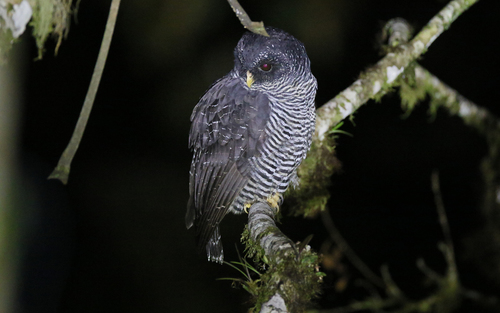
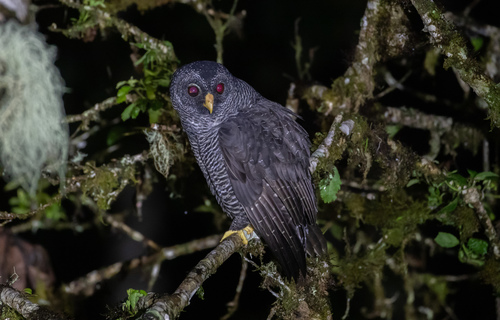
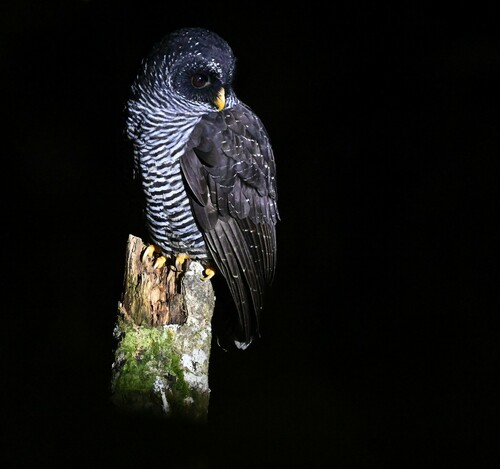
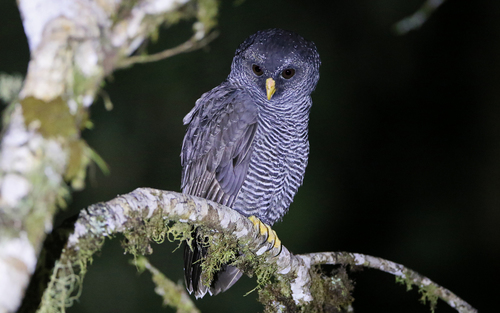
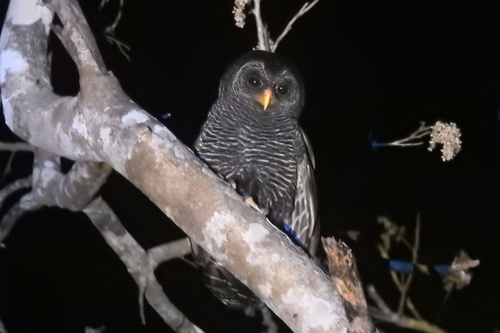
What the Black-banded Owl sounds like


ID tip
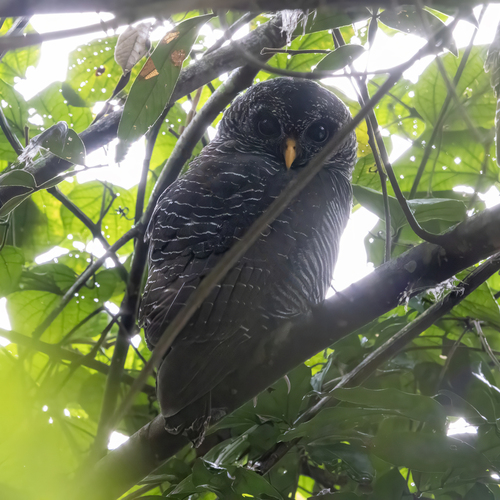
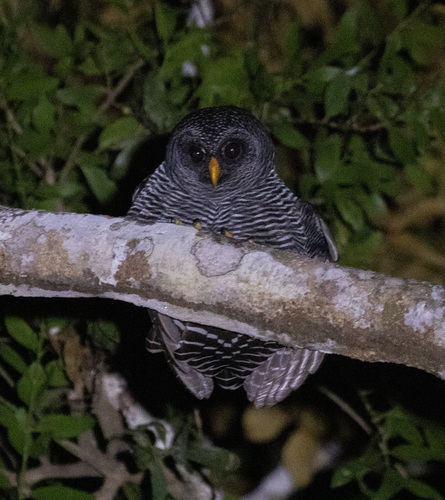
The black-banded owl is medium-sized (30–36 cm (12–14 in)), blackish all over and densely striated with horizontal, wavy, white bars. A black face mask encircle its eyes. It has a rounded head with no ear tufts, and a yellow-orange bill and feet. The tail is sooty-brown, with 4 to 5 narrow white bars and a white terminal band. Primary feathers are significantly darker than the rest of its plumage. Black bristles and feathers are found around the bill and along the leg to the base of the toes. Voice: The song of the male black-banded owl consists of a phrase of changing hoots. The typical rhythm is composed of 3-4 deep guttural notes, followed by a pause of about 0.6 seconds, and ending with one or two louder and shorter hoots. This wobobo whúo or wobobo whúo hú song increases gradually in volume and pitch. The female sings a slightly higher-pitched version of this.
Text from Wikipedia, licensed CC BY-SA 4.0.
When to see the Black-banded Owl
One bar for each month, and every month is filled: this bird is recorded here in all twelve. The wide bar is February, the month with the most records.
Where to see the Black-banded Owl
The map shades 11 countries with regular records. Everything unshaded has no records. Countries are listed below the map.
About the Black-banded Owl
The black-banded owl is a species of owl in the family Strigidae. Entirely nocturnal, this midsized black and white neotropical bird is a resident species, and therefore never migrates out of its native South America. Its natural habitats are varied subtropical or tropical forests ranging from lowlands to areas of medium altitude, and it has been found in Argentina, Bolivia, Brazil, Colombia, Ecuador, French Guiana, Guyana, Paraguay, Peru, Suriname, and Venezuela.
Text adapted from Wikipedia, licensed CC BY-SA 4.0.
Easily confused with
 Rufous-banded OwlStrix albitarsisThe rufous-banded owl is 30 to 35 cm (12 to 14 in) long; two specimens weighed 265 and 350 g (9.3 and 12.3 oz).
 Brown Wood OwlStrix leptogrammicaThe brown wood owl is found in India, Bangladesh, Sri Lanka, Indonesia, Taiwan, and south China.
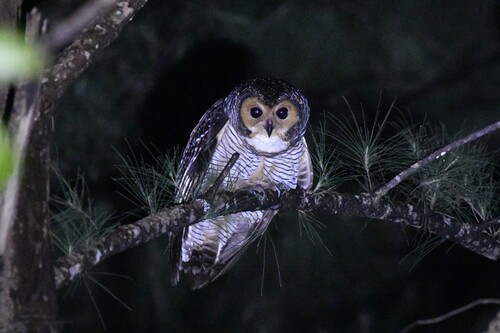 Spotted Wood OwlStrix seloputoThe spotted wood owl grows to a length of about 44 to 48 cm (17 to 19 in) with a wing length of 30 to 36 cm (12 to 14 in).
Side by side: Black-banded Owl vs Mottled Wood Owl · Black-banded Owl vs Rufous-banded Owl
Learn the Black-banded Owl in the BeakBrain App
Photo and call practice. Coming soon to iPhone and Android.
Play today's Daily BirdEvery photo and recording on this page is credited to its author under the licence shown. Spotted a problem with this page, or have a better photo? Contribute.