Learn what every symbol on the card means.Full credits and sources at beakbrain.com/symbols
 GrasslandCup nest43 g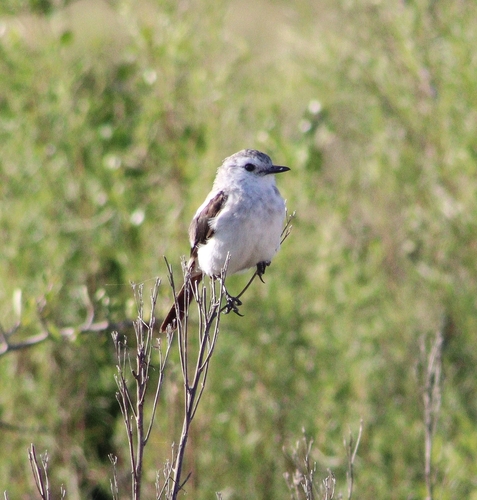
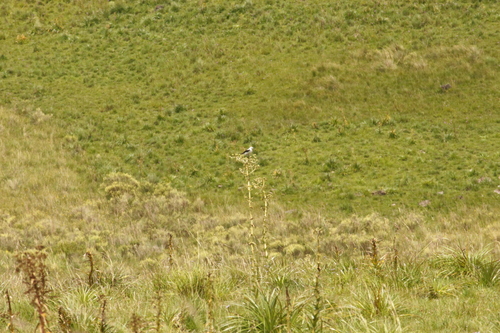


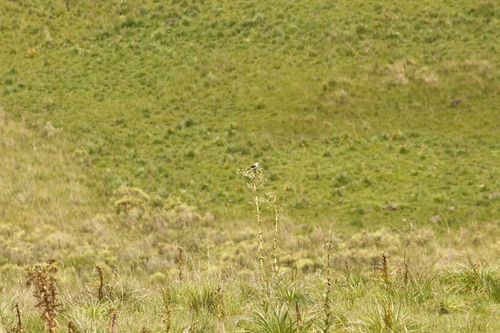
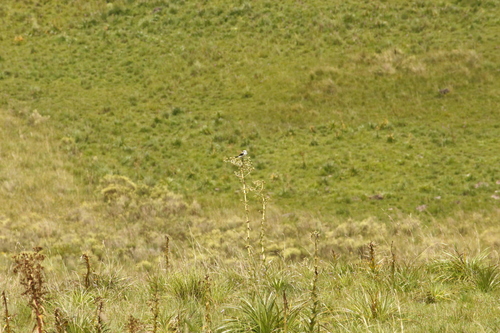
ID tip
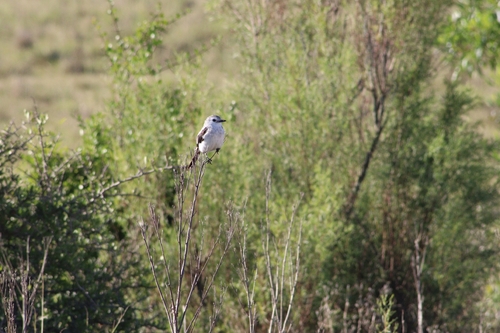
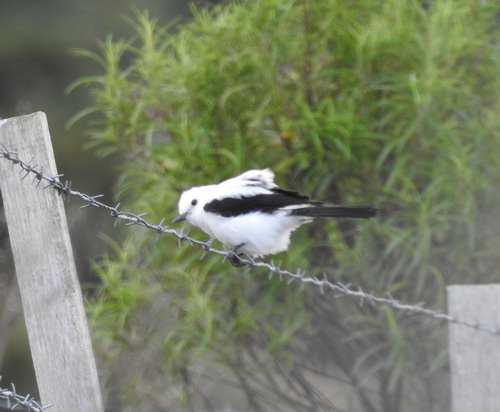
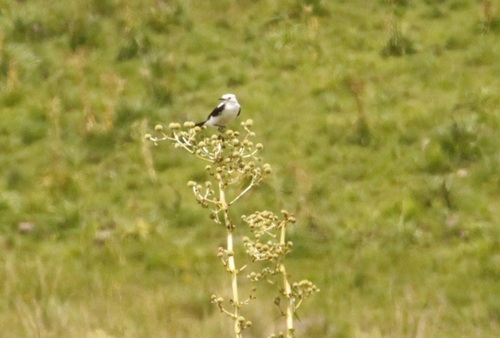
The black-and-white monjita is 20 to 20.5 cm (7.9 to 8.1 in) long. Adult males are mostly white. They have pale grayish smudging on the head and back, black wings with white outer thirds of the primaries, a long black tail, and entirely white underparts. Adult females have a brownish gray crown and back, white scapulars, and a white rump. Both sexes have a dark iris, a black bill, and black legs and feet. Juveniles have a rusty back. Voice: The black-and-white monjita is usually silent but does make a "soft, somewhat querulous weeyrt or wurrt call, especially when agitated".
Text from Wikipedia, licensed CC BY-SA 4.0.
When to see the Black-and-white Monjita
One bar for each month, and every month is filled: this bird is recorded here in all twelve. The wide bar is November, the month with the most records.
Where to see the Black-and-white Monjita
The map shades 3 countries with regular records. Everything unshaded has no records. Countries are listed below the map.
About the Black-and-white Monjita
The black-and-white monjita is a species of passerine bird in the family Tyrannidae, the tyrant flycatchers. It is found in Argentina, Brazil, Uruguay and possibly Paraguay.
Text adapted from Wikipedia, licensed CC BY-SA 4.0.
Easily confused with
 Mottle-backed ElaeniaElaenia gigasThe mottle-backed elaenia is 17.5 to 18.5 cm (6.9 to 7.3 in) long.
 Three-striped FlycatcherConopias trivirgatusThe three-striped flycatcher is the smallest member of genus Conopias.
Snethlage's Tody-TyrantHemitriccus minorSnethlage's tody-tyrant is about 10 cm (3.9 in) long and weighs 7 to 7.9 g (0.25 to 0.28 oz).
Three-striped FlycatcherConopias trivirgatusThe three-striped flycatcher is the smallest member of genus Conopias.
Snethlage's Tody-TyrantHemitriccus minorSnethlage's tody-tyrant is about 10 cm (3.9 in) long and weighs 7 to 7.9 g (0.25 to 0.28 oz).
Side by side: Black-and-white Monjita vs Three-striped Flycatcher · Black-and-white Monjita vs Mottle-backed Elaenia
Learn the Black-and-white Monjita in the BeakBrain App
Photo and call practice. Coming soon to iPhone and Android.
Play today's Daily BirdEvery photo and recording on this page is credited to its author under the licence shown. Spotted a problem with this page, or have a better photo? Contribute.