Learn what every symbol on the card means.Full credits and sources at beakbrain.com/symbols
 ForestDomed nestSmall · 17 g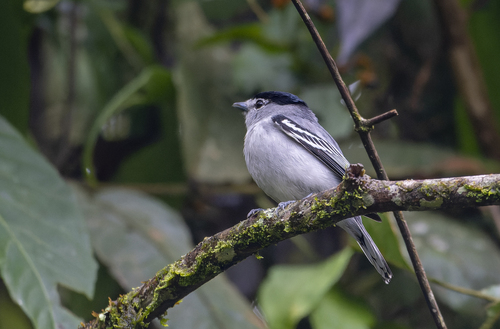
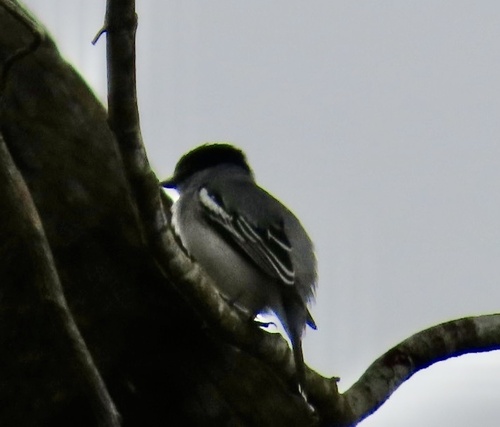

What the Black-and-white Becard sounds like


ID tip
The black-and-white becard is 13.2 to 15.0 cm (5.2 to 5.9 in) long and weighs about 16 to 26 g (0.56 to 0.92 oz). Adult males of the nominate subspecies have a glossy bluish black crown. They have blackish lores, a wide white stripe from above the lores to above the eye, and a thin partial white eye-ring on an otherwise grayish face. Their nape and upperparts through their uppertail coverts are gray. Their wings are mostly black with wide white edges on the secondaries, tertials, and median and greater coverts; the last two show as wing bars. Voice: The male black-and-white becard's song is a "short soft phrase of typically three mellow notes w-tuw-tuweet?" and the species' call a "short rapid trill consisting of a few downslurred notes". Males sing mostly at dawn and in the early morning.
Text from Wikipedia, licensed CC BY-SA 4.0.
When to see the Black-and-white Becard
One bar for each month, and every month is filled: this bird is recorded here in all twelve. The wide bar is March, the month with the most records.
Where to see the Black-and-white Becard
The map shades 6 countries with regular records. Everything unshaded has no records. Countries are listed below the map.
About the Black-and-white Becard
The black-and-white becard is a species of bird in the family Tityridae, the tityras, becards, and allies. Sources differ on its range; all agree it is found in Colombia, Costa Rica, Panama, and Venezuela and some add Ecuador and Peru.
Text adapted from Wikipedia, licensed CC BY-SA 4.0.
Easily confused with
 Jamaican BecardPachyramphus nigerThe Jamaican becard is about 18 cm (7.1 in) long and weighs about 39 to 41.5 g (1.4 to 1.5 oz).
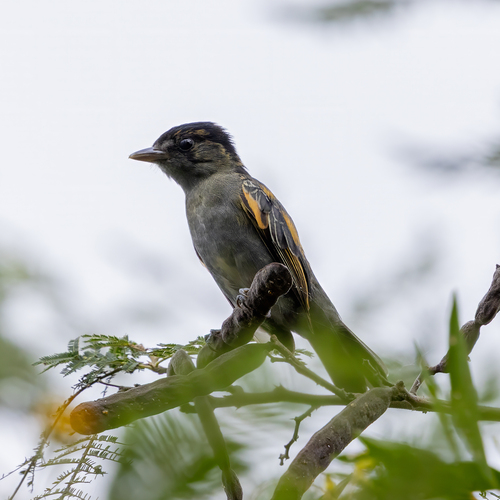 Slaty BecardPachyramphus spodiurusThe slaty becard is about 14 cm (5.5 in) long.
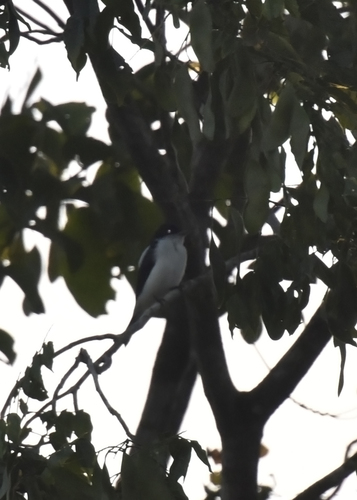 Glossy-backed BecardPachyramphus surinamusThe glossy-backed becard is about 13 to 14 cm (5.1 to 5.5 in) long and weighs about 20 g (0.71 oz).
Learn the Black-and-white Becard in the BeakBrain App
Photo and call practice. Coming soon to iPhone and Android.
Play today's Daily BirdEvery photo and recording on this page is credited to its author under the licence shown. Spotted a problem with this page, or have a better photo? Contribute.