Learn what every symbol on the card means.Full credits and sources at beakbrain.com/symbols
 Woodland

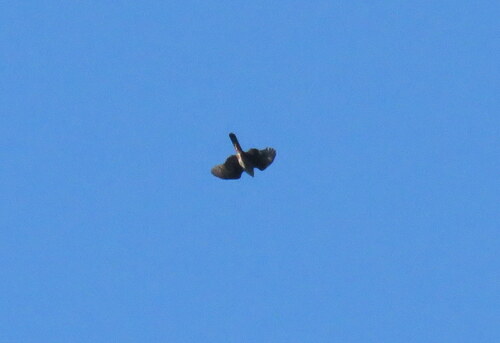
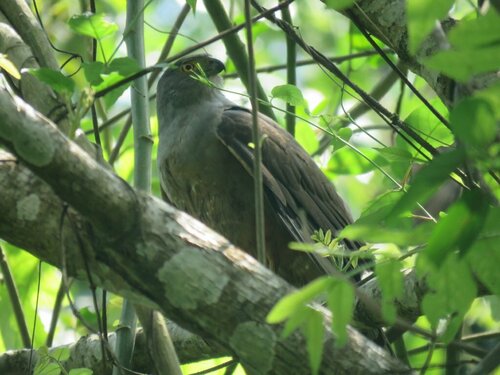
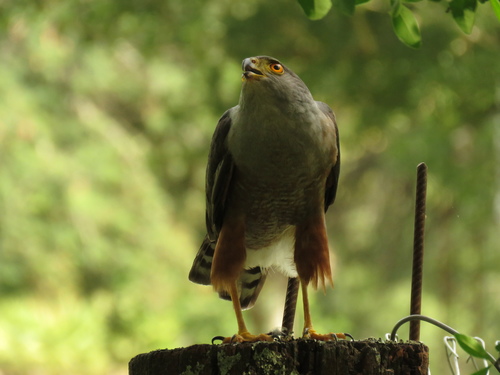
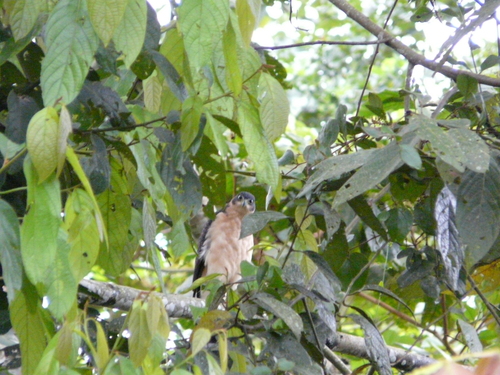
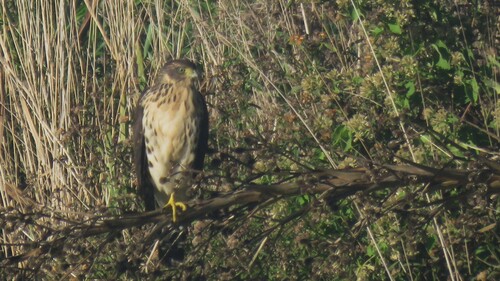
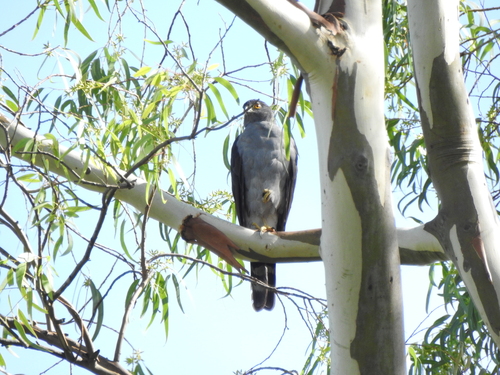
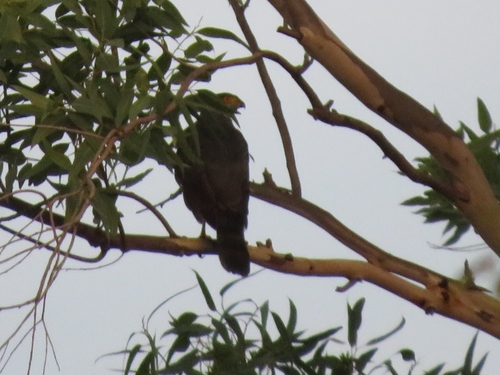
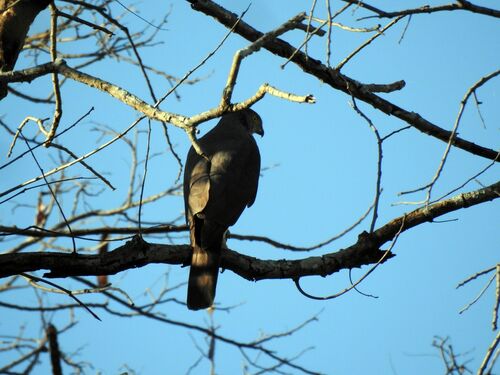
ID tip
At 34–45 centimetres (13–18 in) in length and 200–450 grams (7.1–15.9 oz) in weight, it is significantly smaller than the northern goshawk of Eurasia and North America, and somewhat smaller than the Cooper's hawk of North America, but it is among the largest hawks in Central and South America (only the rare grey-bellied hawk is larger). As in other hawks, the female is far larger than the male. Adults are grey above with darker wings and crown, and a banded tail. The underparts typically vary from dark grey to very pale grey, but the southern subspecies can sometimes be rufescent below. Voice: Its vocalisations are mainly subdued and unnoticeable. Males have been heard to give a soft, clear whistle and females can emit a loud "cac cac cac" when around the nest and young. A barking "kra-kra-kra-kr-kr-kr-ka" may also be heard from both sexes. During incubation, males give a sharp "kek" vocalisation upon arrival to the nest with food, to which the female replies with a nasal "wreh".
Text from Wikipedia, licensed CC BY-SA 4.0.
About the Bicolored Hawk
The bicolored hawk is a species of bird of prey in the family Accipitridae. It is found in forest, woodland, second growth, plantations, and wooded savanna in southeastern Mexico, Central America, and northern and central South America. Though generally uncommon, it is the most common species of Astur in most of its range, but it does not occur at altitudes above 2,700 metres (8,900 ft) such as the highest parts of the Andes.
Text adapted from Wikipedia, licensed CC BY-SA 4.0.
Easily confused with
 Cooper's HawkAstur cooperiiCooper's hawk is a medium-sized hawk as well as roughly average to small-sized for an Astur species.
 Gundlach's HawkAstur gundlachiThe hawk is a medium-sized forest raptor.
Chilean HawkAstur chilensisThe male is 37 to 38 cm long, while the larger female measures 41 to 42 cm.
Gundlach's HawkAstur gundlachiThe hawk is a medium-sized forest raptor.
Chilean HawkAstur chilensisThe male is 37 to 38 cm long, while the larger female measures 41 to 42 cm.
Learn the Bicolored Hawk in the BeakBrain App
Photo and call practice. Coming soon to iPhone and Android.
Play today's Daily BirdEvery photo and recording on this page is credited to its author under the licence shown. Spotted a problem with this page, or have a better photo? Contribute.