Learn what every symbol on the card means.Full credits and sources at beakbrain.com/symbols
 ShrublandSmall · 19 g
ID tip
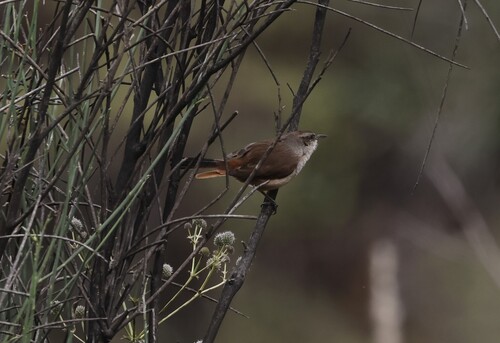
Berlepsch's canastero is 15 to 16 cm (5.9 to 6.3 in) long. Adults have an inconspicuous gray supercilium and blackish lores and ear coverts. Their crown is warm brown that becomes paler and duller on their back. Their rump and uppertail coverts are rufous. Their wings are mostly blackish with dark rufous edges and tips on their coverts. Their tail's outermost pair of feathers are rufous, the next pair partly rufous and partly blackish, and the rest fully blackish. Voice: The song of Berlepsch's canastero is a trill that is similar to that of the rusty-vented canastero. That species' song "may begin with a series of introductory notes, but these apparently are not always given. The song then...accelerates and ascends, before descending and decelerating near the end".
Text from Wikipedia, licensed CC BY-SA 4.0.
When to see the Berlepsch's Canastero
One bar for each month. Filled bars are the 6 months with records; pale bars are months with none. The wide bar is October, the month with the most records.
Where to see the Berlepsch's Canastero
The map shades 1 country with regular records. Everything unshaded has no records. Countries are listed below the map.
About the Berlepsch's Canastero
Berlepsch's canastero is a species of bird in the Furnariinae subfamily of the ovenbird family Furnariidae. It is endemic to Bolivia.
Text adapted from Wikipedia, licensed CC BY-SA 4.0.
Easily confused with
 Eye-ringed ThistletailAsthenes palpebralisThe eye-ringed thistletail is 18 to 20 cm (7.1 to 7.9 in) long and weighs 16 to 18 g (0.56 to 0.63 oz).
Ochre-browed ThistletailAsthenes coryiThe ochre-browed thistletail is 16 to 18 cm (6.3 to 7.1 in) long and weighs 15 to 18 g (0.53 to 0.63 oz).
Cipo CanasteroAsthenes luizaeThe Cipo canastero is about 17 cm (6.7 in) long and weighs 25.5 to 30.5 g (0.90 to 1.1 oz).
Eye-ringed ThistletailAsthenes palpebralisThe eye-ringed thistletail is 18 to 20 cm (7.1 to 7.9 in) long and weighs 16 to 18 g (0.56 to 0.63 oz).
Ochre-browed ThistletailAsthenes coryiThe ochre-browed thistletail is 16 to 18 cm (6.3 to 7.1 in) long and weighs 15 to 18 g (0.53 to 0.63 oz).
Cipo CanasteroAsthenes luizaeThe Cipo canastero is about 17 cm (6.7 in) long and weighs 25.5 to 30.5 g (0.90 to 1.1 oz).
Learn the Berlepsch's Canastero in the BeakBrain App
Photo and call practice. Coming soon to iPhone and Android.
Play today's Daily BirdEvery photo and recording on this page is credited to its author under the licence shown. Spotted a problem with this page, or have a better photo? Contribute.