Learn what every symbol on the card means.Full credits and sources at beakbrain.com/symbols
 GrasslandDomed nestSmall · 49 g


ID tip
A typical little buttonquail, rufous-brown above, rusty and buff below. Chin, throat and breast closely barred with black. Female larger and more richly coloured, with throat and middle of breast black. The blue-grey bill and legs, and yellowish white eyes are diagnostic, as are also the pale buff shoulder-patches on the wings when in flight. Absence of hind toe distinguishes Bustard and Button quails from true quails. Pairs, in scrub and grassland. The calls are a motorcycle-like drr-r-r-r-r-r and a loud hoon- hoon-hoon.
Text from Wikipedia, licensed CC BY-SA 4.0.
When to see the Barred Buttonquail
One bar for each month, and every month is filled: this bird is recorded here in all twelve. The wide bar is September, the month with the most records.
Where to see the Barred Buttonquail
The map shades 19 countries with regular records. Everything unshaded has no records. Countries are listed below the map.
About the Barred Buttonquail
The barred buttonquail or common bustard-quail is a buttonquail, one of a small family of birds which resemble, but are not closely related to, the true quails. This species is resident from India across tropical Asia to south China, Indonesia and the Philippines.
Text adapted from Wikipedia, licensed CC BY-SA 4.0.
Easily confused with
 Painted ButtonquailTurnix variusThe painted buttonquail is about 19 to 20 cm (7.5 to 7.9 in) long.
 Common ButtonquailTurnix sylvaticusThe common buttonquail resembles the common quail.
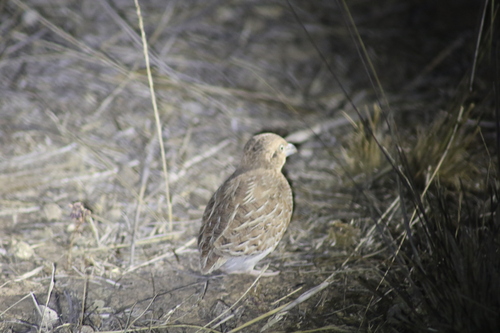 Little ButtonquailTurnix veloxThe little buttonquail is a small reddish brown bird with thin white stripes on its upper parts with a blue-grey beak, pink legs and feet, and pale eyes.
Side by side: Barred Buttonquail vs Painted Buttonquail · Barred Buttonquail vs Common Buttonquail · Barred Buttonquail vs Little Buttonquail
Learn the Barred Buttonquail in the BeakBrain App
Photo and call practice. Coming soon to iPhone and Android.
Play today's Daily BirdEvery photo and recording on this page is credited to its author under the licence shown. Spotted a problem with this page, or have a better photo? Contribute.