Learn what every symbol on the card means.Full credits and sources at beakbrain.com/symbols
 ForestMedium · 72 g
What the Barred Antthrush sounds like


ID tip
The rufous-tailed antthrush is 19 to 20.5 cm (7.5 to 8.1 in) long and weighs about 69 to 80 g (2.4 to 2.8 oz). The sexes are alike. Adults have a chestnut to dark brown crown. They have whitish lores, a white streak with black bars behind their eye, a chestnut streak below the eye, and black and white barred ear coverts. Their upperparts, wings, and tail are mostly chestnut to dark brown with a slightly more rufescent rump and uppertail coverts. Their throat has narrow black and white bars. Their underparts are mostly dark brown to black with narrow white or buff bars and brown lower flanks. Voice: The barred antthrush's song is "a series of similar notes at even pace of 6–7 per second, increasing steadily in volume and in pitch...increasing variably throughout song or through first half and then levelling, sometimes pace slowing and pitch slightly lowering over final few seconds" and can last up to 30 seconds. It has been written as "pupupupupupupupupupupupupupuPUPUPUPUPU'PU'PU'PU' PU".
Text from Wikipedia, licensed CC BY-SA 4.0.
When to see the Barred Antthrush
One bar for each month. Filled bars are the 10 months with records; pale bars are months with none. The wide bar is October, the month with the most records.
Where to see the Barred Antthrush
The map shades 4 countries with regular records. Everything unshaded has no records. Countries are listed below the map.
About the Barred Antthrush
The barred antthrush is a species of bird in the family Formicariidae. It is found in Bolivia, Colombia, Ecuador and Peru.
Text adapted from Wikipedia, licensed CC BY-SA 4.0.
Easily confused with
 Striated AntthrushChamaeza nobilisThe striated antthrush is 22 to 23 cm (8.7 to 9.1 in) long and weighs about 120 to 150 g (4.2 to 5.3 oz).
 Schwartz's AntthrushChamaeza turdinaSchwartz's antthrush is 19 to 19.5 cm (7.5 to 7.7 in) long.
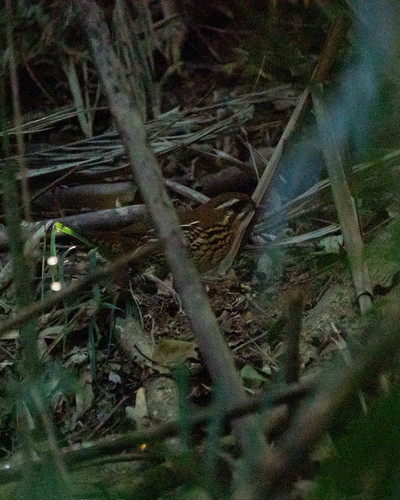 Rufous-tailed AntthrushChamaeza ruficaudaThe rufous-tailed antthrush is 19 to 20 cm (7.5 to 7.9 in) long and weighs about 63 to 125 g (2.2 to 4.4 oz).
Learn the Barred Antthrush in the BeakBrain App
Photo and call practice. Coming soon to iPhone and Android.
Play today's Daily BirdEvery photo and recording on this page is credited to its author under the licence shown. Spotted a problem with this page, or have a better photo? Contribute.