Learn what every symbol on the card means.Full credits and sources at beakbrain.com/symbols
 ForestCavity nestLarge · 578 g


ID tip
The barking owl is coloured brown with white spots on its wings and a vertically streaked chest. They have large eyes that have a yellow iris, a discrete facial mask and yellow skin on the feet. Their underparts are brownish-grey and coarsely spotted white with their tail and flight feathers being strongly banded brown and white. They are a robust, medium-sized owl 39–44 cm (15–17 in) long and their wingspan is between 85 and 120 cm (33 and 47 in). They weigh between 380 and 960 g (13 and 34 oz). Voice: Most people hear the barking owl rather than see it as it has a loud and explosive voice. The main territorial vocalisation is in the form of a double 'hoot', similar in pattern to the other Australian hawk owls. It sounds like a double dog bark, so closely resembling a small dog that it is difficult to tell the difference. The barking owl name is derived from these calls.
Text from Wikipedia, licensed CC BY-SA 4.0.
When to see the Barking Owl
One bar for each month. Filled bars are the 11 months with records; pale bars are months with none. The wide bar is July, the month with the most records.
Where to see the Barking Owl
The map shades 3 countries with regular records. Everything unshaded has no records. Countries are listed below the map.
About the Barking Owl
The barking owl or barking boobook, also known as the winking owl, is a nocturnal bird species native to mainland Australia and parts of New Guinea and the Moluccas. They are medium-sized brown owls and have a characteristic voice with calls ranging from a barking dog noise to an intense human-like howl.
Text adapted from Wikipedia, licensed CC BY-SA 4.0.
Easily confused with
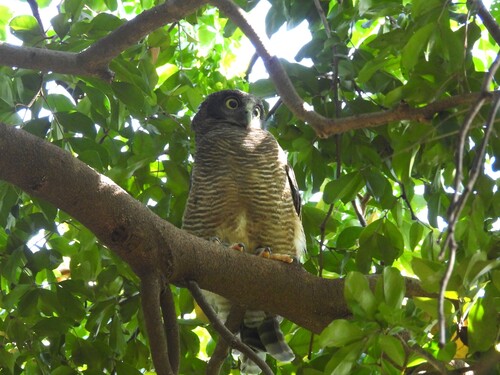 Rufous OwlNinox rufaThe rufous owl is a large bird, often growing to 46–57 cm (18–22 in) in length, with a wingspan of 100 to 120 cm (39 to 47 in).
Hume's BoobookNinox obscuraHume's boobook or Hume's hawk-owl is a species of owl in the family Strigidae endemic to the Andaman Islands.
Rufous OwlNinox rufaThe rufous owl is a large bird, often growing to 46–57 cm (18–22 in) in length, with a wingspan of 100 to 120 cm (39 to 47 in).
Hume's BoobookNinox obscuraHume's boobook or Hume's hawk-owl is a species of owl in the family Strigidae endemic to the Andaman Islands.
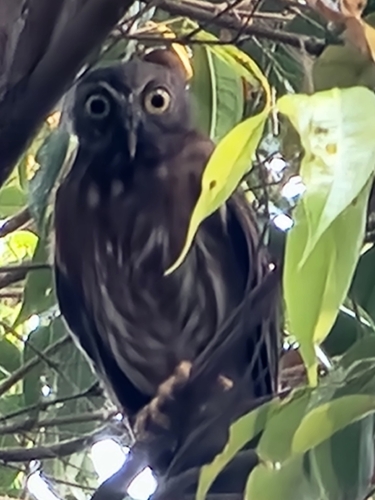 Luzon BoobookNinox philippensisThe Luzon boobook is one of the smallest of the owls in the Philippine hawk-owl complex.
Side by side: Barking Owl vs Powerful Owl · Barking Owl vs Brown Boobook · Barking Owl vs Flammulated Owl
Learn the Barking Owl in the BeakBrain App
Photo and call practice. Coming soon to iPhone and Android.
Play today's Daily BirdEvery photo and recording on this page is credited to its author under the licence shown. Spotted a problem with this page, or have a better photo? Contribute.