Learn what every symbol on the card means.Full credits and sources at beakbrain.com/symbols
 GrasslandCavity nestSmall · 23 g


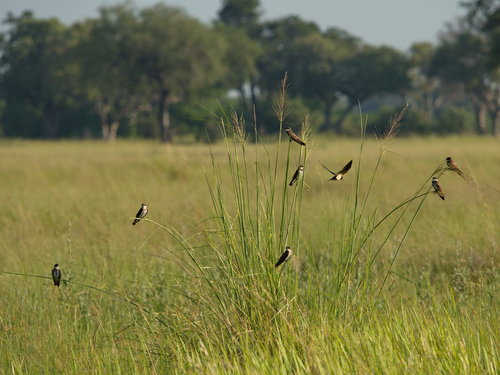
ID tip
The 15–17 cm (5.9–6.7 in) long banded martin has earth-brown upper parts, except for a white stripe above the eye. Its underparts are white, as are the underwing coverts, and it has a dark brown breast band, and sometimes a thin dark line across the vent. Sexes are similar, but the young have a paler breast band and golden tips to the upper part feathers. It is easily distinguished from the smaller sand martin by its square tail and white on the underwings, and from the brown-throated sand martin by its white throat.
Text from Wikipedia, licensed CC BY-SA 4.0.
When to see the Banded Martin
One bar for each month. Filled bars are the 9 months with records; pale bars are months with none. The wide bar is November, the month with the most records.
Where to see the Banded Martin
The map shades 21 countries with regular records, and 1 more in a lighter tone where the bird turns up only as a stray. Everything unshaded has no records. Countries are listed below the map.
Recorded as a rare visitor in Central African Republic.
About the Banded Martin
The banded martin or banded sand martin is a small passerine bird in the swallow family Hirundinidae that is endemic to Africa. It is the only species placed in the genus Neophedina.
Text adapted from Wikipedia, licensed CC BY-SA 4.0.
Easily confused with
 Streak-throated SwallowPetrochelidon fluvicolaThe streak-throated swallow is a sparrow-sized bird about 11 cm (4.3 in) in length.
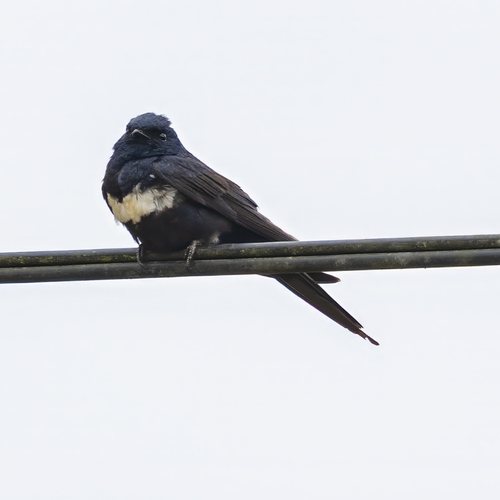 White-banded SwallowAtticora fasciataThe white-banded swallow is a medium-sized swallow, measuring, on average, 15 cm (5.9 in) and weighing 12–16 g (0.42–0.56 oz).
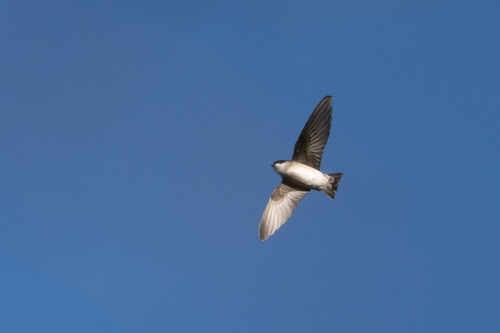 Asian House MartinDelichon dasypusThe adult Asian house martin of the nominate subspecies is 12 cm (4.7 in) long, dark steel blue above with a contrasting white rump, grey-washed white underparts, and a slightly forked tail.
Side by side: Banded Martin vs White-banded Swallow · Asian House Martin vs Banded Martin · Banded Martin vs Streak-throated Swallow
Learn the Banded Martin in the BeakBrain App
Photo and call practice. Coming soon to iPhone and Android.
Play today's Daily BirdEvery photo and recording on this page is credited to its author under the licence shown. Spotted a problem with this page, or have a better photo? Contribute.