Learn what every symbol on the card means.Full credits and sources at beakbrain.com/symbols
 ForestTiny · 11 g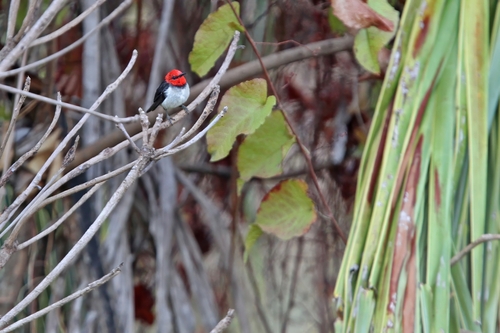


ID tip
The species has sexual dimorphism. The male has a distinctive red head, neck, upper breast, and mantle, black eye ring, scapulars, and wings, a distinctive pointed beak and brown legs. The female is primarily brown, with an orange part underneath the also-pointed beak. The juveniles are not described. The subspecies M. b. annabellae differs from subspecies M. b. boiei in that the males have a white chest instead of a black one.
Text from Wikipedia, licensed CC BY-SA 4.0.
When to see the Banda Myzomela
One bar for each month. Filled bars are the 5 months with records; pale bars are months with none. The wide bar is October, the month with the most records.
Where to see the Banda Myzomela
The map shades 1 country with regular records. Everything unshaded has no records. Countries are listed below the map.
About the Banda Myzomela
The Banda myzomela is a bird species in the family Meliphagidae. It is endemic to Indonesia, and found in the Banda, Babar and the Tanimbar Islands. The two subspecies usually recognised are separated by 350 km (220 mi) of open sea.
Text adapted from Wikipedia, licensed CC BY-SA 4.0.
Easily confused with
Learn the Banda Myzomela in the BeakBrain App
Photo and call practice. Coming soon to iPhone and Android.
Play today's Daily BirdEvery photo and recording on this page is credited to its author under the licence shown. Spotted a problem with this page, or have a better photo? Contribute.