Learn what every symbol on the card means.Full credits and sources at beakbrain.com/symbols
 ForestScrapeSmall · 27 g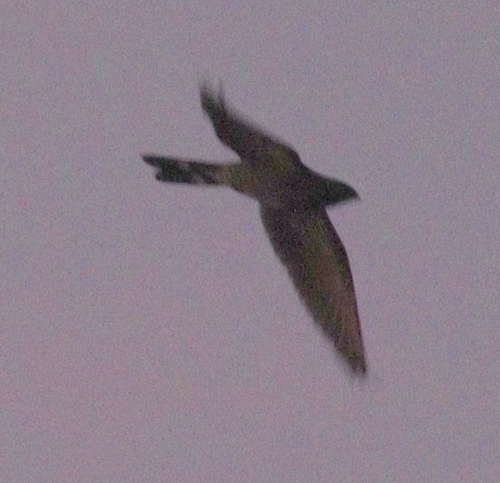
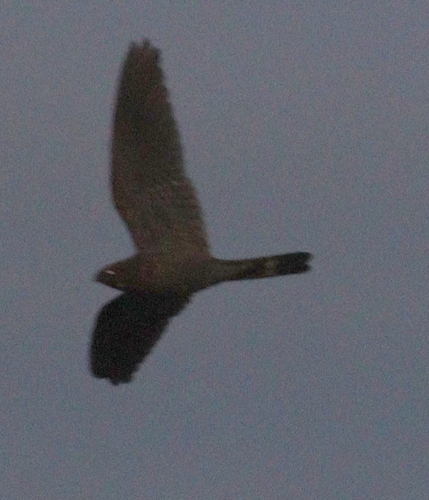
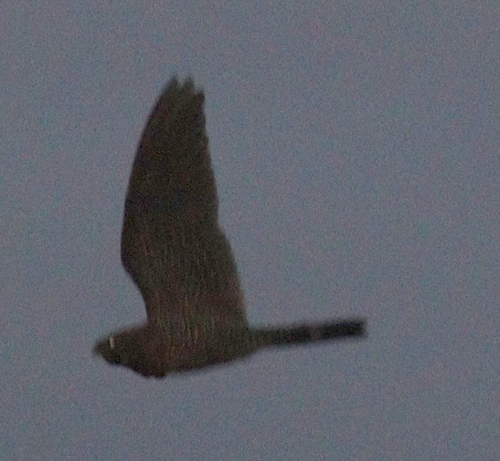
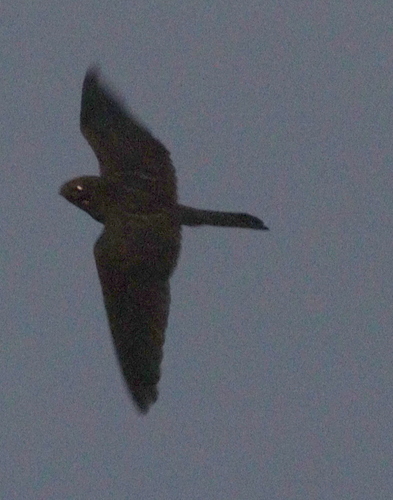
ID tip
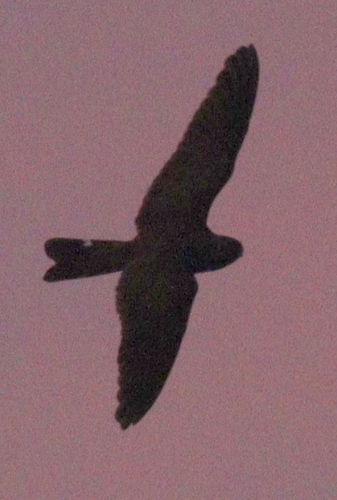
The band-tailed nighthawks is a small species, with a body length of 16.5 to 19 cm (6.5 to 7.5 in), and a wingspan of 12.9 to 14.1 cm (5.1 to 5.6 in). Adults weigh from 0.023 to 0.028 kg (0.051 to 0.062 lb). The female has a larger average weight and wingspan than the male. The bill is very wide but short, with a length of 0.9 to 0.97 cm (0.35 to 0.38 in), and is hooked at the tip. It has cryptically patterned brown plumage, used to blend in with tree bark and leaves. Its wings are long with pointed wingtips, and have no white markings. Voice: Few vocalizations have been recorded for the band-tailed nighthawk. It has a gole-kwoik-kwak call that is at a similar pitch to a frog's ribbit, and is repeated steadily and at a low, subtle volume; it is considered a territorial call.
Text from Wikipedia, licensed CC BY-SA 4.0.
When to see the Band-tailed Nighthawk
One bar for each month. Filled bars are the 10 months with records; pale bars are months with none. The wide bar is August, the month with the most records.
Where to see the Band-tailed Nighthawk
The map shades 8 countries with regular records, and 1 more in a lighter tone where the bird turns up only as a stray. Everything unshaded has no records. Countries are listed below the map.
Recorded as a rare visitor in Ecuador.
About the Band-tailed Nighthawk
The band-tailed nighthawk is a species of nightjar in the family Caprimulgidae. It is widely spread throughout northern and central South America. Five subspecies are recognised. They are nocturnal birds that feed on flying insects. As with almost all nightjars, they lay their eggs directly on the ground and rely their camouflaged plumage to avoid predation.
Text adapted from Wikipedia, licensed CC BY-SA 4.0.
Easily confused with
Learn the Band-tailed Nighthawk in the BeakBrain App
Photo and call practice. Coming soon to iPhone and Android.
Play today's Daily BirdEvery photo and recording on this page is credited to its author under the licence shown. Spotted a problem with this page, or have a better photo? Contribute.