Learn what every symbol on the card means.Full credits and sources at beakbrain.com/symbols
 ShrublandCup nestTiny · 9 g
ID tip
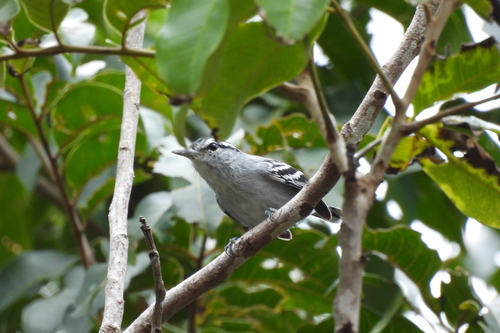
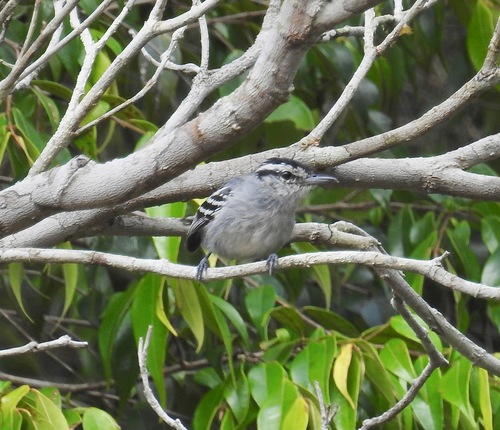
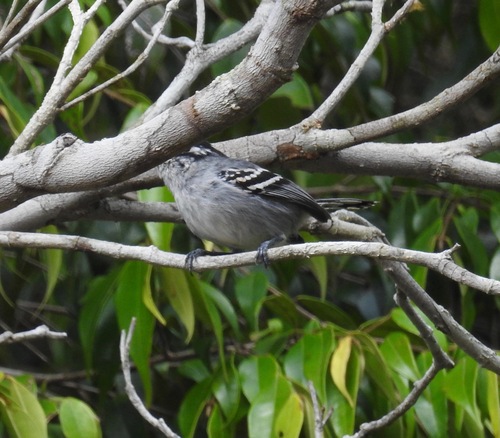
The Bahia antwren is 10.5 to 11 cm (4.1 to 4.3 in) long and weighs about 9 g (0.32 oz). Adult males have a black crown and nape, a long white to pale gray supercilium, and a black streak through the eye. The rest of their upperparts are gray with white-edged blackish scapulars and a white patch between them. Their wings are black with white tips on the coverts and white edges on the flight feathers. Their tail is black with white feather tips and white edges on the outermost. Their underparts are white with a gray wash. Adult females have a buffish forehead and black and white streaked crown. Voice: The Bahia antwren's song is a "fast series of very high, rising 'toot' notes, accelerating to a rattle" and lasts two to three seconds. Its calls include a "short note sounding like 'greep' " and a "rather slow-paced rattle".
Text from Wikipedia, licensed CC BY-SA 4.0.
When to see the Bahia Antwren
One bar for each month. Filled bars are the 11 months with records; pale bars are months with none. The wide bar is January, the month with the most records.
Where to see the Bahia Antwren
The map shades 1 country with regular records. Everything unshaded has no records. Countries are listed below the map.
About the Bahia Antwren
The Bahia antwren or pileated antwren is a Vulnerable species of bird in subfamily Thamnophilinae of family Thamnophilidae, the "typical antbirds". It is endemic to Brazil.
Text adapted from Wikipedia, licensed CC BY-SA 4.0.
Easily confused with
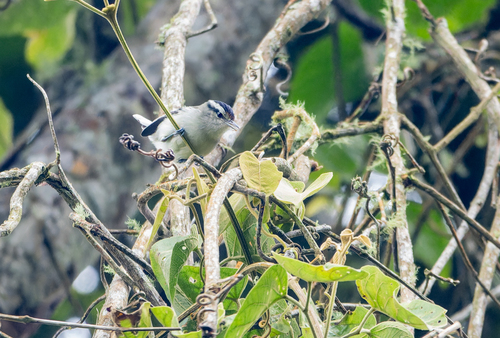 Creamy-bellied AntwrenHerpsilochmus motacilloidesThe creamy-bellied antwren is about 12 cm (4.7 in) long and weighs about 10.5 to 13 g (0.37 to 0.46 oz).
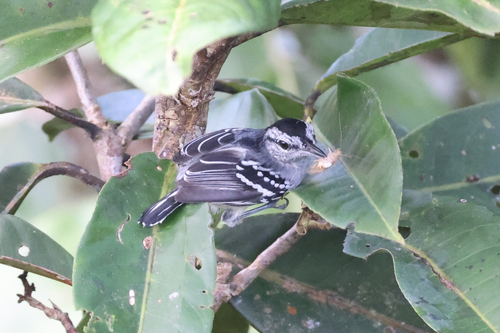 Dugand's AntwrenHerpsilochmus dugandiDugand's antwren is 10 to 11.5 cm (3.9 to 4.5 in) long and weighs 9.3 to 11.3 g (0.33 to 0.40 oz).
 Spot-tailed AntwrenHerpsilochmus sticturusThe spot-tailed antwren is 9.5 to 10.5 cm (3.7 to 4.1 in) long and weighs 8 to 9 g (0.28 to 0.32 oz).
Learn the Bahia Antwren in the BeakBrain App
Photo and call practice. Coming soon to iPhone and Android.
Play today's Daily BirdEvery photo and recording on this page is credited to its author under the licence shown. Spotted a problem with this page, or have a better photo? Contribute.