Learn what every symbol on the card means.Full credits and sources at beakbrain.com/symbols
 WoodlandCavity nestMedium · 67 g
ID tip
The babbling starlings are 17 cm and 64-72 grams . They can be identified by their yellow chest with a black wedge in the center of their breast and their bright yellow eyes with an off-white colored head and a light brown color on top that fades into dark greyish brown wings that have a dash of white on them forming a band on the folded wing . They have dark brown tails, sexes look alike . The babbling's can also be identified by their slur squealing sounds or rather raspy scolding call .
Text from Wikipedia, licensed CC BY-SA 4.0.
When to see the Babbling Starling
One bar for each month. Filled bars are the 8 months with records; pale bars are months with none. The wide bar is October, the month with the most records.
Where to see the Babbling Starling
The map shades 3 countries with regular records. Everything unshaded has no records. Countries are listed below the map.
About the Babbling Starling
The babbling starling is a species of starling in the family Sturnidae. It is monotypic within the genus Neocichla. It is found in the African countries of Angola, Malawi, Tanzania, and Zambia. The babbling starling is a small starling that consists of yellow, dark brown, grey, and black coloring. There are two subspecies that include the Babbling starling western and the Babbling starling eastern. They are not globally threatened but are poorly known. Their diet can consist of termites, berries, and flowers that are usually on the ground. Their generation length in years is 4.16.
Text adapted from Wikipedia, licensed CC BY-SA 4.0.
Easily confused with
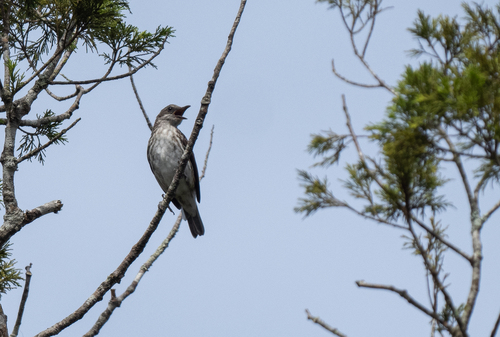 Visayan RhabdornisRhabdornis raboriWas formerly conspecific with the stripe-breasted rhabdornis and grand rhabdornis but is differentiated by pale brownish gray mask, paler gray crown and plainer head, brown-gray throat and black spotting on neck and a longer tail.
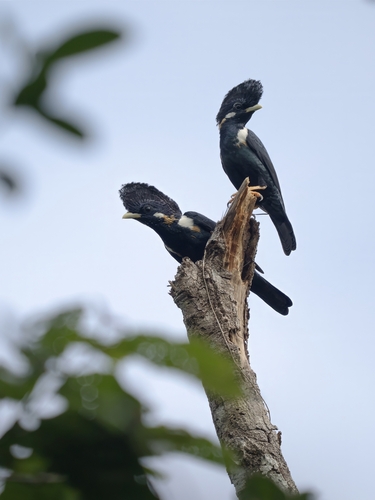 Helmeted MynaBasilornis galeatusIt is black with white spots on its face with a significant helmet-like crest.
Learn the Babbling Starling in the BeakBrain App
Photo and call practice. Coming soon to iPhone and Android.
Play today's Daily BirdEvery photo and recording on this page is credited to its author under the licence shown. Spotted a problem with this page, or have a better photo? Contribute.