Learn what every symbol on the card means.Full credits and sources at beakbrain.com/symbols
 ForestCavity nestMedium · 121 g


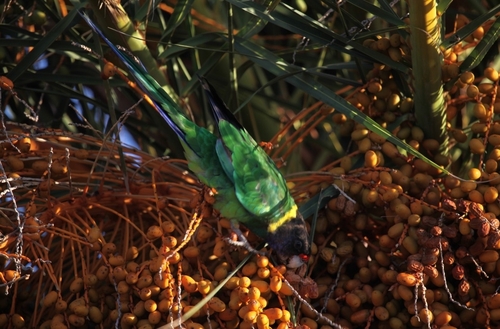
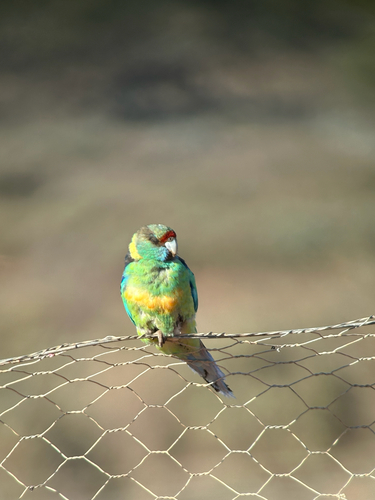
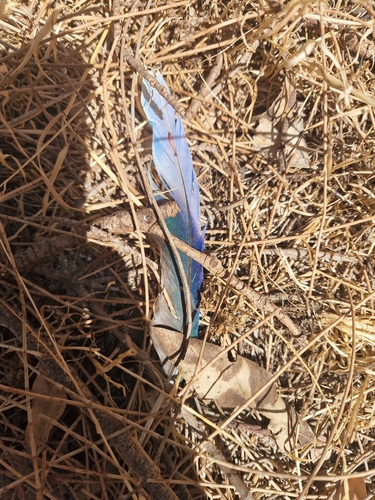

ID tip
The subspecies of the Australian ringneck differ considerably in colouration. It is a medium size species around 33 cm (13 in) long. The basic colour is green, and all four subspecies have the characteristic yellow ring around the hindneck; wings and tail are a mixture of green and blue. The B. z. zonarius and B. z. semitorquatus subspecies have a dull black head; back, rump and wings are brilliant green; throat and breast bluish-green. The difference between these two subspecies is that B. z. zonarius has a yellow abdomen while B. z.
Text from Wikipedia, licensed CC BY-SA 4.0.
When to see the Australian Ringneck
One bar for each month, and every month is filled: this bird is recorded here in all twelve. The wide bar is October, the month with the most records.
Where to see the Australian Ringneck
The map shades 1 country with regular records, and 1 more in a lighter tone where the bird turns up only as a stray. Everything unshaded has no records. Countries are listed below the map.
Recorded as a rare visitor in United Kingdom.
About the Australian Ringneck
The Australian ringneck is a parrot native to Australia. Except for extreme tropical and highland areas, the species has adapted to all conditions. Treatments of genus Barnardius have previously recognised two species, the Port Lincoln parrot and the mallee ringneck, but due to these readily interbreeding at the contact zone they are usually regarded as a single species B. zonarius with subspecific descriptions. Currently, four subspecies are recognised, each with a distinct range.
Text adapted from Wikipedia, licensed CC BY-SA 4.0.
Easily confused with
 Vernal Hanging ParrotLoriculus vernalisThe vernal hanging parrot is a small parrot which is a resident breeder in the Indian subcontinent and some other areas of Southeast Asia.
 Scaly-breasted LorikeetTrichoglossus chlorolepidotusThe scaly-breasted lorikeet is about 23 cm (9.1 in) long.
 Alexandrine ParakeetPsittacula eupatriaThe Alexandrine parakeet is one of the largest parakeets, measuring 56 to 62 cm (22 to 24 in) from the top of the head to the tip of the tail and weighing 200 to 300 g (7.1 to 10.6 oz).
Side by side: Australian Ringneck vs Scaly-breasted Lorikeet · Alexandrine Parakeet vs Australian Ringneck
Learn the Australian Ringneck in the BeakBrain App
Photo and call practice. Coming soon to iPhone and Android.
Play today's Daily BirdEvery photo and recording on this page is credited to its author under the licence shown. Spotted a problem with this page, or have a better photo? Contribute.