Learn what every symbol on the card means.Full credits and sources at beakbrain.com/symbols
 MarineCavity nestMedium · 111 g


ID tip
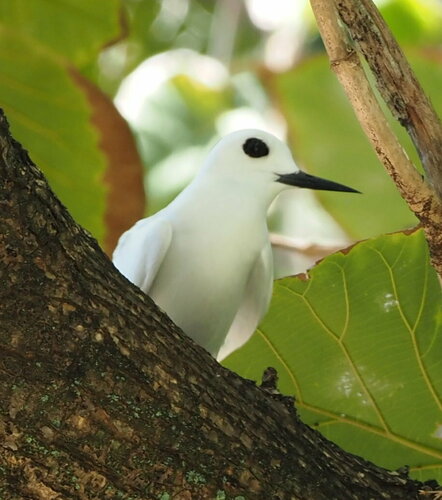
The Atlantic white tern is 23–30 cm (9.1–11.8 in) long with a wingspan of 76–87 cm (30–34 in). It has pure white plumage, except for a dark streak along the shafts of the outer primary feathers in G. a. candida), a black eye accentuated by a narrow ring of black feathers round the eye, and a long black to bluish-black bill. The tail is shallowly forked, but like in the noddies, with the longest feathers the second-from outermost, not the outermost as in other terns. The legs are dark grey, to paler grey in G. a. leucopes and G. a. microrhyncha.
Text from Wikipedia, licensed CC BY-SA 4.0.
When to see the Atlantic White Tern
One bar for each month, and every month is filled: this bird is recorded here in all twelve. The wide bar is March, the month with the most records.
Where to see the Atlantic White Tern
The map shades 32 countries with regular records, and 9 more in a lighter tone where the bird turns up only as a stray. Everything unshaded has no records. Countries are listed below the map.
Recorded as a rare visitor in Taiwan, France, India, Bermuda, Panama, Mayotte, Chile, Mexico, Nauru.
About the Atlantic White Tern
The Atlantic white tern, also known as the common white tern, is a small seabird found in the Atlantic Ocean. It is sometimes known as the fairy tern, although this name is potentially confusing as it is also the common name of Sternula nereis. Other names for the species include angel tern and white noddy. The blue-billed white tern and the little white tern have sometimes been considered as subspecies of the Atlantic white tern.
Text adapted from Wikipedia, licensed CC BY-SA 4.0.
Easily confused with

Learn the Atlantic White Tern in the BeakBrain App
Photo and call practice. Coming soon to iPhone and Android.
Play today's Daily BirdEvery photo and recording on this page is credited to its author under the licence shown. Spotted a problem with this page, or have a better photo? Contribute.