Learn what every symbol on the card means.Full credits and sources at beakbrain.com/symbols
 ForestCavity nestTiny · 11 g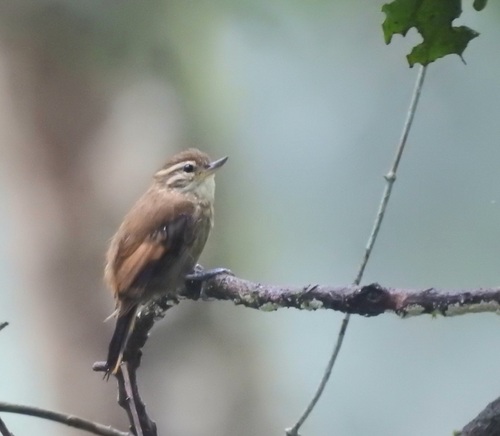



What the Atlantic Plain Xenops sounds like


ID tip
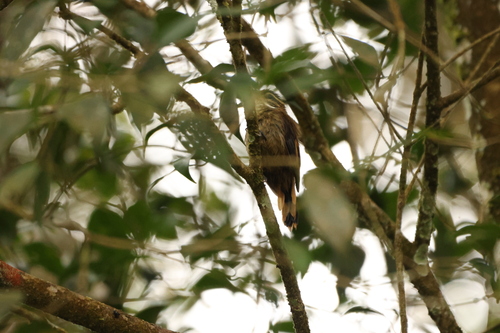
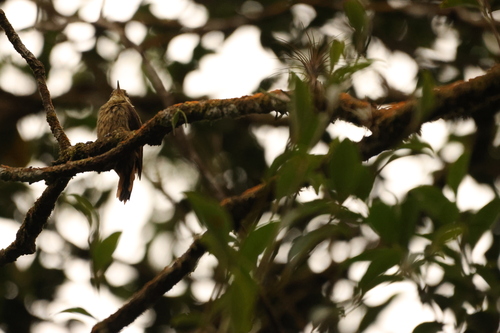
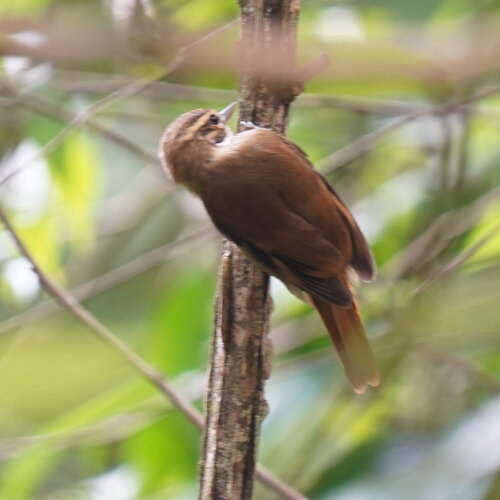
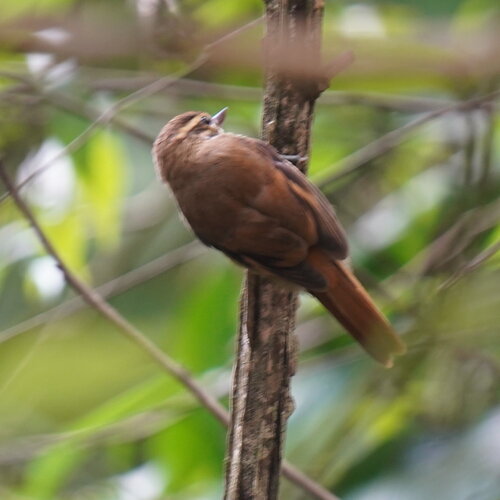
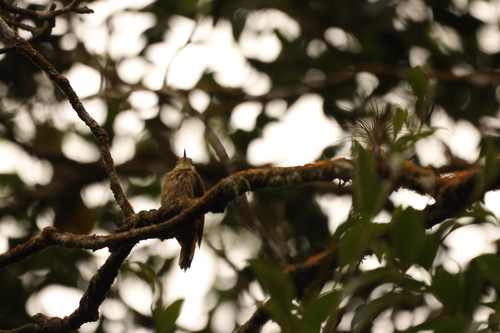
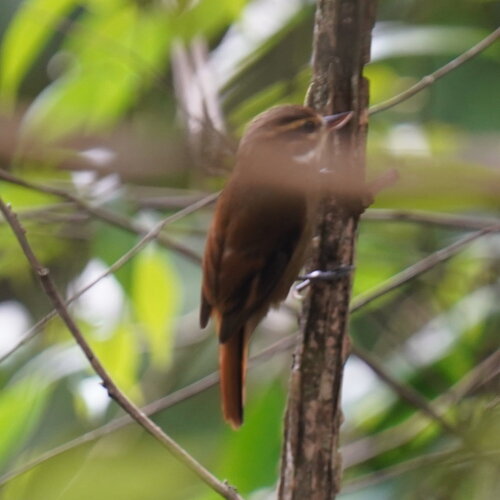
The Atlantic plain xenops is about 12 cm (4.7 in) long and weighs about 10 to 13 g (0.35 to 0.46 oz). Its bill is wedge-shaped, fairly stubby, and slightly upturned. The sexes are alike and juveniles resemble adults. Adults have a conspicuous buff or whitish supercilium and a wide pure white malar stripe. Their upperparts are dull brown to rufous brown and unstreaked; their crown is darker and lightly streaked. Their tail is cinnamon with much black. Their wings are also cinnamon, with a wide tawny or ochraceous band on the flight feathers. Their throat is pale with little or no streaking. Voice: The Atlantic plain xenops' song is a "series of 4-7 upslurred (or underslurred) notes, the first one often slightly lower pitched and subdued: wee-kwee-kwee-kwee-kweet!" Its call is a "short emphatic upslurred note kweet!, uttered singly or several times with intervals of typically 1.5‒3s".
Text from Wikipedia, licensed CC BY-SA 4.0.
When to see the Atlantic Plain Xenops
One bar for each month, and every month is filled: this bird is recorded here in all twelve. The wide bar is October, the month with the most records.
Where to see the Atlantic Plain Xenops
The map shades 7 countries with regular records, and 6 more in a lighter tone where the bird turns up only as a stray. Everything unshaded has no records. Countries are listed below the map.
Recorded as a rare visitor in Mexico, Peru, Costa Rica, Ecuador, Belize, Venezuela.
About the Atlantic Plain Xenops
The Atlantic plain xenops, also known as the white-throated xenops, is a passerine bird in the Furnariinae subfamily of the ovenbird family Furnariidae. It is found in Argentina, Brazil, and Paraguay.
Text adapted from Wikipedia, licensed CC BY-SA 4.0.
Easily confused with
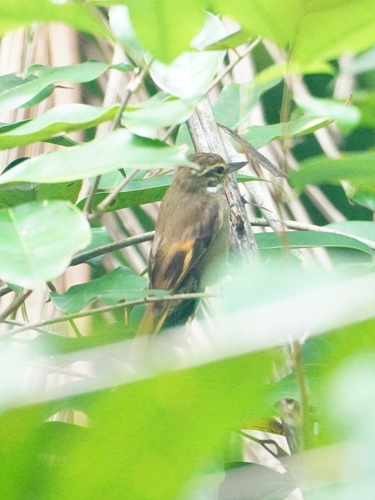 Amazonian Plain XenopsXenops genibarbisThe Amazonian plain xenops has a wedge-shaped, fairly stubby, and slightly upturned bill.
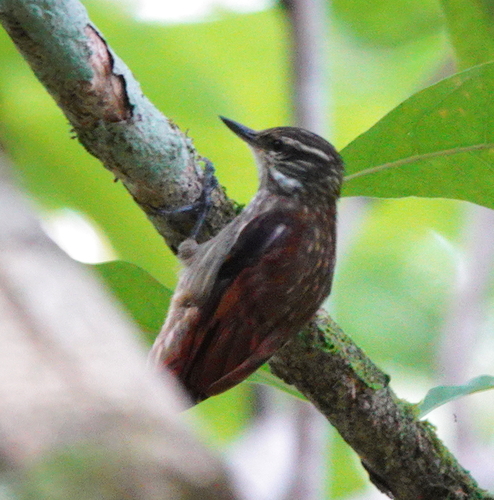 Slender-billed XenopsXenops tenuirostrisThe slender-billed xenops is 10 to 11.5 cm (3.9 to 4.5 in) long and weighs 9 to 11 g (0.32 to 0.39 oz).
 Northern Plain XenopsXenops mexicanusThe northern plain xenops is 11 to 13 cm (4.3 to 5.1 in) long.
Learn the Atlantic Plain Xenops in the BeakBrain App
Photo and call practice. Coming soon to iPhone and Android.
Play today's Daily BirdEvery photo and recording on this page is credited to its author under the licence shown. Spotted a problem with this page, or have a better photo? Contribute.