Learn what every symbol on the card means.Full credits and sources at beakbrain.com/symbols
 Grassland14 g


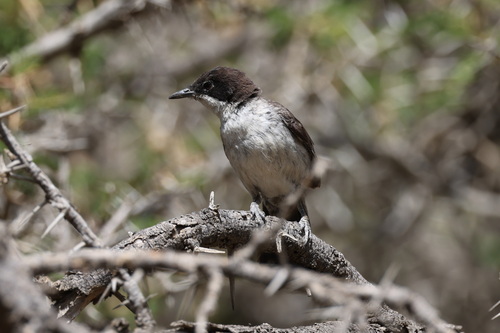
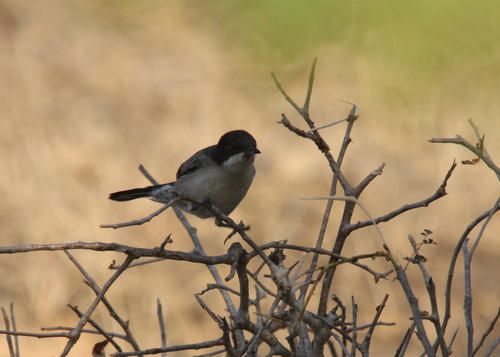
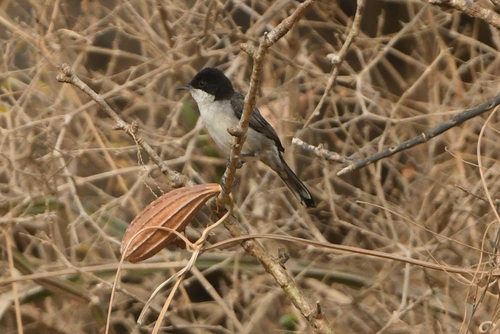
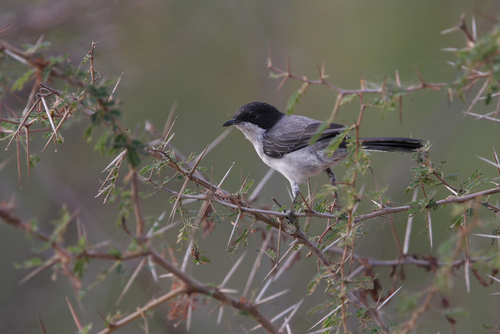
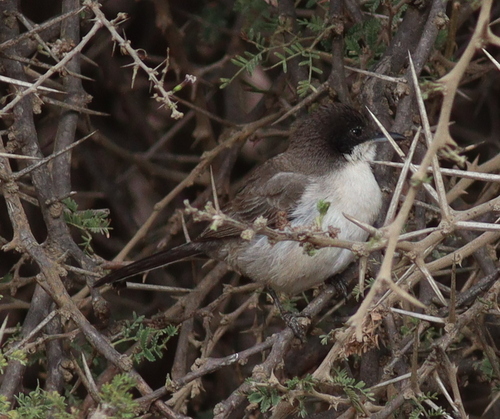
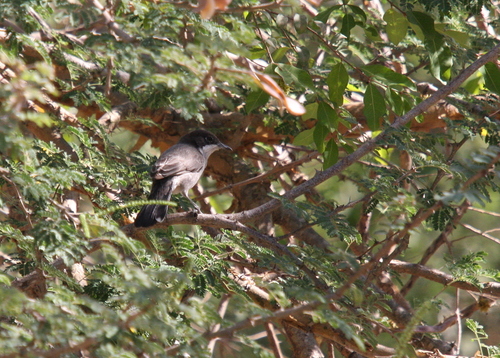
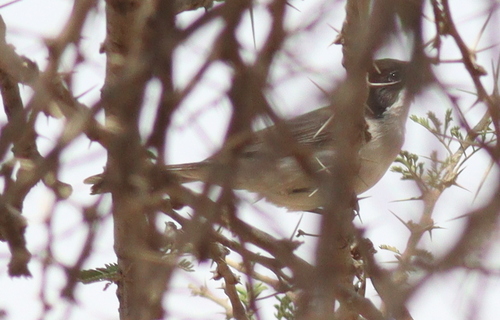
ID tip
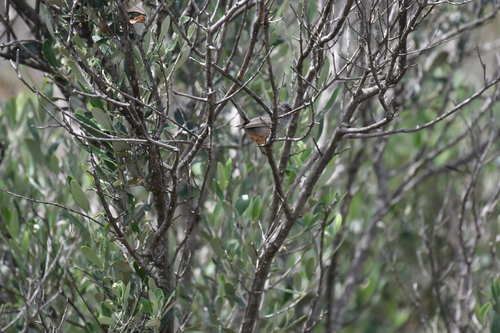
The Arabian warbler is a large member of its genus, with a length of about 14.5 cm (5.7 in). It has an upright posture, relatively short, rounded wings and a long, graduated tail which it characteristically flicks downwards. The male has a white eye-ring, a blackish-brown hood and tail, greyish-brown upper parts, a whitish throat and pale grey underparts. The female is similar but the hood and tail are chocolate brown and the eye ring is less conspicuous.
Text from Wikipedia, licensed CC BY-SA 4.0.
When to see the Arabian Warbler
One bar for each month. Filled bars are the 9 months with records; pale bars are months with none. The wide bar is November, the month with the most records.
Where to see the Arabian Warbler
The map shades 6 countries with regular records, and 2 more in a lighter tone where the bird turns up only as a stray. Everything unshaded has no records. Countries are listed below the map.
About the Arabian Warbler
The Arabian warbler, also known as Red Sea warbler or Blandford's warbler, is a species of Old World warbler in the family Sylviidae. It is found in Djibouti, Egypt, Eritrea, Israel, Jordan, Oman, Palestine, Saudi Arabia, Somalia, Sudan, and Yemen. Its natural habitat is dry savanna country where it is often found in patches of Acacia.
Text adapted from Wikipedia, licensed CC BY-SA 4.0.
Easily confused with
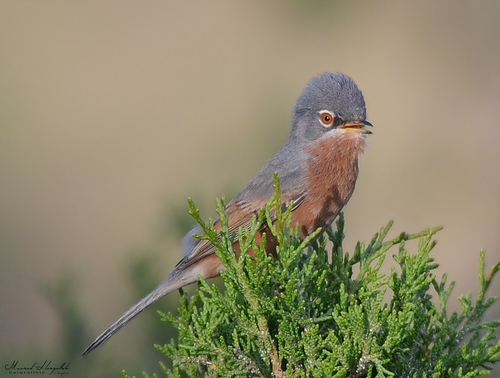 Tristram's WarblerCurruca deserticolaTristram's warbler is a species of Old World warbler in the family Sylviidae.
 African Desert WarblerCurruca desertiIt is a small bird, marginally the smallest in the genus, 11–12 cm long, and 7–10 g weight.
 Balearic WarblerCurruca balearicaThe Balearic warbler is a warbler species of the genus Curruca.
Learn the Arabian Warbler in the BeakBrain App
Photo and call practice. Coming soon to iPhone and Android.
Play today's Daily BirdEvery photo and recording on this page is credited to its author under the licence shown. Spotted a problem with this page, or have a better photo? Contribute.