Learn what every symbol on the card means.Full credits and sources at beakbrain.com/symbols
 MarinePlatform nestHuge · 7.0 kg


ID tip
The Antipodean is large, at 110 cm (43 in) in length. Its breeding plumage is brown and white and its juveniles are similar in appearance to the snowy albatross. Breeding females have brown upper parts, and have white vermiculations on their back. Its face, throat, lower breast, and belly are white, and its undertail coverts are brown. Its underwings are also white, but with a dark tip.
Text from Wikipedia, licensed CC BY-SA 4.0.
When to see the Antipodean Albatross
One bar for each month. Filled bars are the 11 months with records; pale bars are months with none. The wide bar is December, the month with the most records.
Where to see the Antipodean Albatross
The map shades 3 countries with regular records, and 1 more in a lighter tone where the bird turns up only as a stray. Everything unshaded has no records. Countries are listed below the map.
Recorded as a rare visitor in United States.
About the Antipodean Albatross
The Antipodean albatross is a large seabird in the albatross family. Its recognition as more than a subspecies of the wandering albatross is relatively recent, and still not accepted by all authorities. Antipodean albatrosses are smaller than other former wandering albatrosses, now called snowy albatrosses, and breed in predominantly brown plumage, but are otherwise difficult to distinguish from young snowy albatrosses.
Text adapted from Wikipedia, licensed CC BY-SA 4.0.
Easily confused with
 Northern Royal AlbatrossDiomedea sanfordiThe northern royal albatross is typically about 115 cm (45 in) tall, weighs 6.2 to 8.2 kg (14–18 lb), and has a wingspan from 270 to 305 cm (106–120 in).
 Southern Royal AlbatrossDiomedea epomophoraThe southern royal albatross has a length of 112 to 123 cm (44–48 in) and a mean weight of 8.5 kg (19 lb).
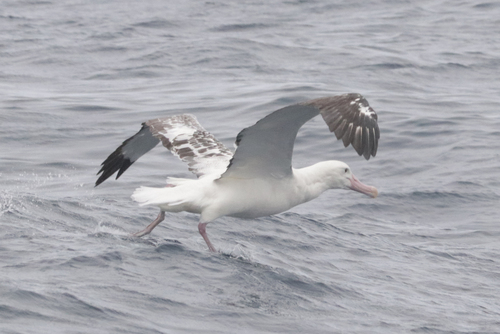 Tristan AlbatrossDiomedea dabbenenaThe Tristan albatross is practically indistinguishable from the snowy albatross at sea but is smaller and has a slightly darker back.
Side by side: Antipodean Albatross vs Snowy Albatross · Antipodean Albatross vs Southern Royal Albatross · Antipodean Albatross vs Northern Royal Albatross
Learn the Antipodean Albatross in the BeakBrain App
Photo and call practice. Coming soon to iPhone and Android.
Play today's Daily BirdEvery photo and recording on this page is credited to its author under the licence shown. Spotted a problem with this page, or have a better photo? Contribute.