Learn what every symbol on the card means.Full credits and sources at beakbrain.com/symbols
 WoodlandCavity nestSmall · 32 g


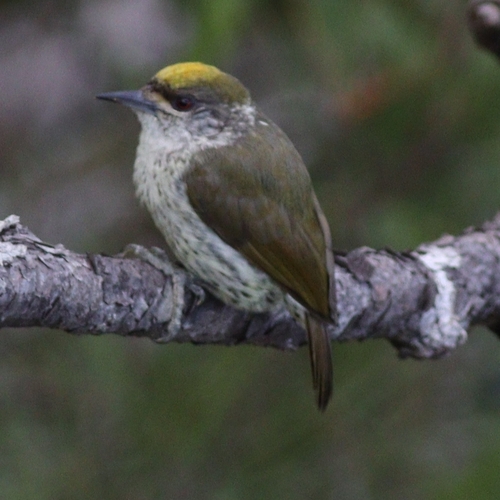
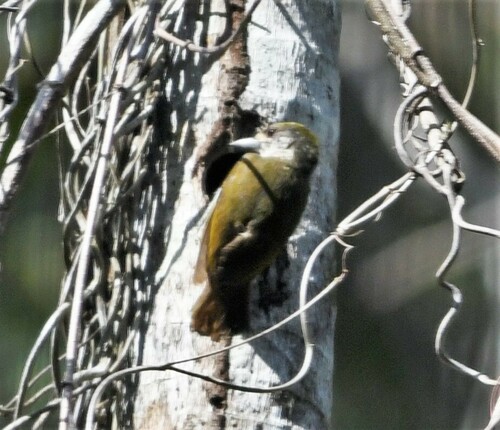
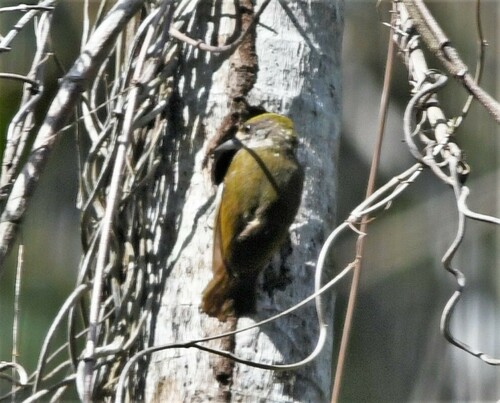
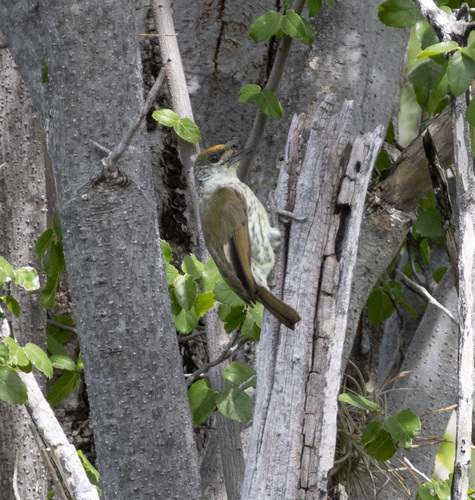
ID tip
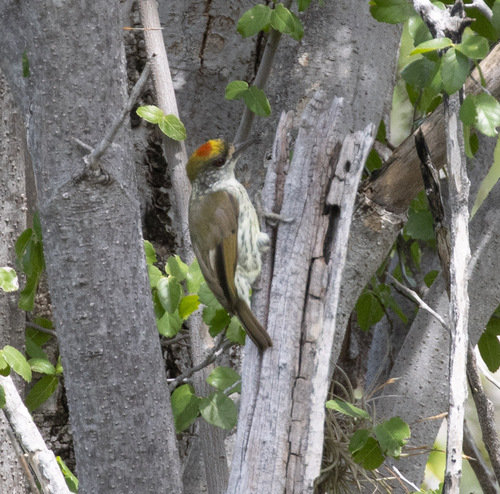
The Antillean piculet is 14 to 16 cm (5.5 to 6.3 in) long and weighs 26 to 33 g (0.92 to 1.2 oz). It is the largest piculet, and is about double the size of the Neotropical piculets of genus Picumnus. Adult males of the nominate subspecies have a lemon yellow crown with an orange-red to red patch in the center. Their hindneck is yellowish green and their upperparts dull olive green to yellow-green with a faint rusty-bronze tinge. Their wings are olive green and the flight feathers have yellow-green edges. Their tail is browish olive with a bronze cast. Voice: The Antillean piculet has a variety of vocalizations. Members of a pair use "kuk-ki-ki-ki-ke-ku-kuk" as a contact and territorial call. Its alarm calls are "mechanical 'pit' and 'pew' notes" and it makes a "continuous noisy 'yeh-yeh-yeh-yeh' chatter during fights". In contrast to many other woodpeckers, it is not known to drum.
Text from Wikipedia, licensed CC BY-SA 4.0.
When to see the Antillean Piculet
One bar for each month. Filled bars are the 8 months with records; pale bars are months with none. The wide bar is February, the month with the most records.
Where to see the Antillean Piculet
The map shades 2 countries with regular records. Everything unshaded has no records. Countries are listed below the map.
About the Antillean Piculet
The Antillean piculet is a species of bird in subfamily Picinae of the woodpecker family Picidae. It is endemic to the Caribbean island of Hispaniola that is shared by the Dominican Republic and Haiti.
Text adapted from Wikipedia, licensed CC BY-SA 4.0.
Easily confused with
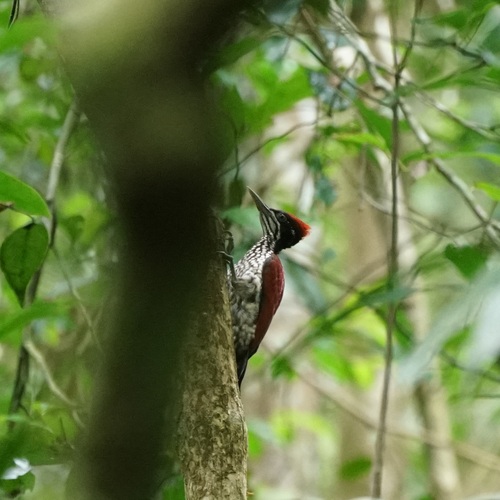 Crimson-backed FlamebackChrysocolaptes stricklandiThe crimson-backed flameback or greater Sri Lanka flameback is a species of bird in the woodpecker family Picidae that is endemic to Sri Lanka.
 Bar-bellied WoodpeckerVeniliornis nigricepsThe bar-bellied woodpecker is 17 to 20 cm (6.7 to 7.9 in) long and weighs 39 to 46 g (1.4 to 1.6 oz).
 Black-necked WoodpeckerColaptes atricollisThe black-necked woodpecker is 26 to 27 cm (10 to 11 in) long and weighs 73 to 90 g (2.6 to 3.2 oz).
Learn the Antillean Piculet in the BeakBrain App
Photo and call practice. Coming soon to iPhone and Android.
Play today's Daily BirdEvery photo and recording on this page is credited to its author under the licence shown. Spotted a problem with this page, or have a better photo? Contribute.