Learn what every symbol on the card means.Full credits and sources at beakbrain.com/symbols
 MarineCavity nestLarge · 708 g

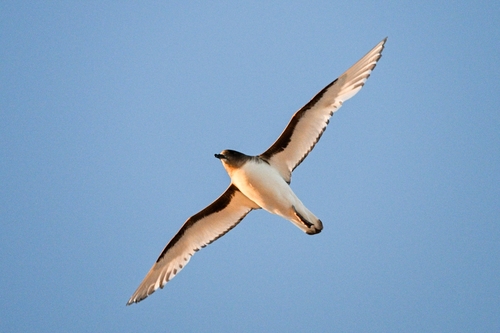
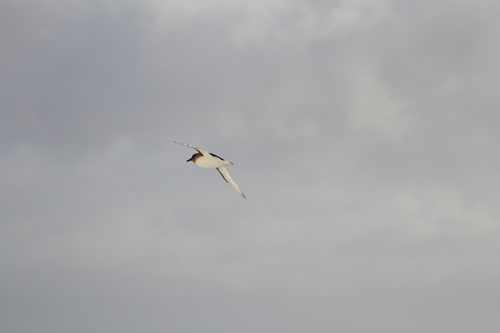
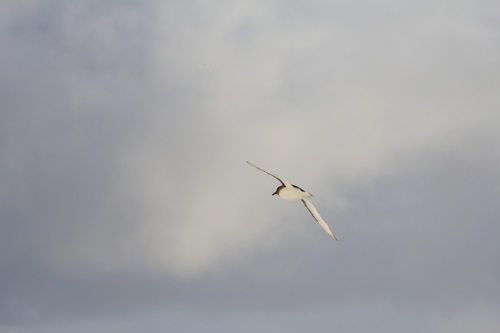

ID tip
The adult Antarctic petrel has a brown head, sides, throat, and back. The bill is dark brown and the feet are grey. The underparts are white and their tail and secondaries on the wings are white with brown tips. These are medium-sized relative to other petrels with a wingspan of 100–110 cm (39–43 in), a length of 40–45 cm (16–18 in), and an average weight of 675 g (23.8 oz).
Text from Wikipedia, licensed CC BY-SA 4.0.
When to see the Antarctic Petrel
One bar for each month. Filled bars are the 5 months with records; pale bars are months with none. The wide bar is December, the month with the most records.
Where to see the Antarctic Petrel
The map shades 1 country with regular records, and 3 more in a lighter tone where the bird turns up only as a stray. Everything unshaded has no records. Countries are listed below the map.
Recorded as a rare visitor in Australia, New Zealand, Chile.
About the Antarctic Petrel
The Antarctic petrel is a boldly marked dark brown and white petrel, found in Antarctica, most commonly in the Ross and Weddell Seas. They eat Antarctic krill, fish, and small squid. They feed while swimming but can dive from both the surface and the air.
Text adapted from Wikipedia, licensed CC BY-SA 4.0.
Easily confused with
 South Georgia Diving PetrelPelecanoides georgicusThe South Georgia diving petrel is a small, plump petrel, 180 to 220 mm (7.1–8.7 in) in length and weighing around 90 to 150 g (3.2–5.3 oz).
 Snow PetrelPagodroma niveaThe snow petrel is a small, pure white fulmarine petrel with coal-black eyes, a small black bill and bluish gray feet.
Learn the Antarctic Petrel in the BeakBrain App
Photo and call practice. Coming soon to iPhone and Android.
Play today's Daily BirdEvery photo and recording on this page is credited to its author under the licence shown. Spotted a problem with this page, or have a better photo? Contribute.